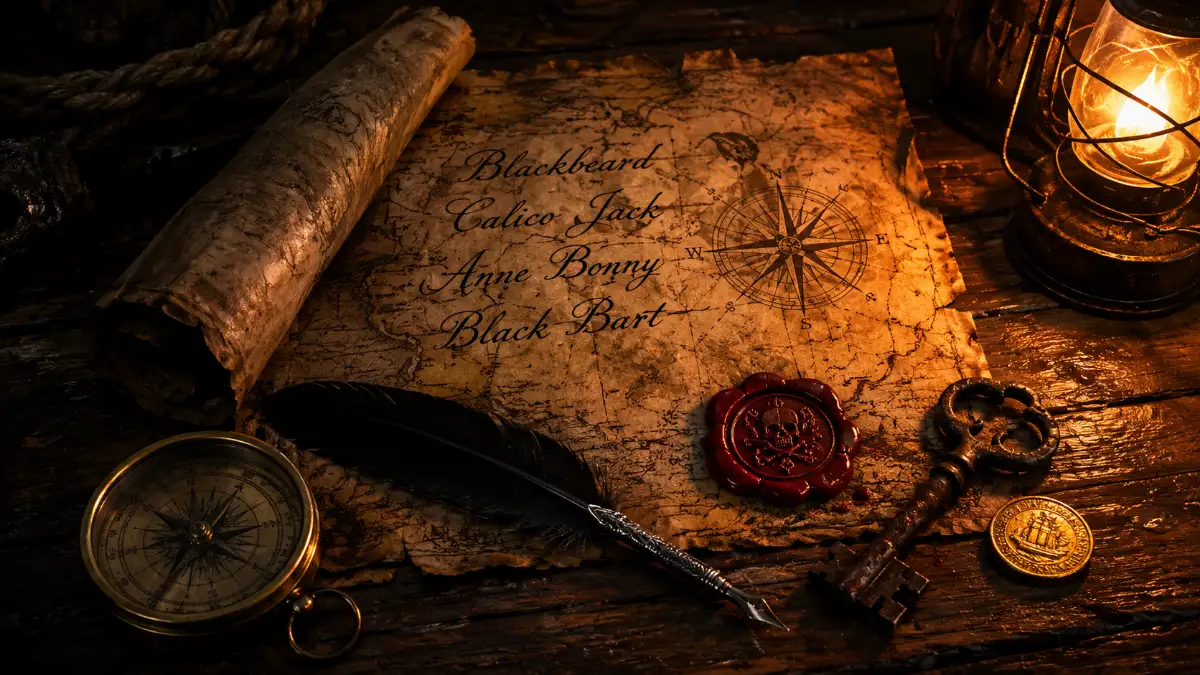
From Blackbeard’s terrifying reign to Jack Sparrow’s stumbling genius the names that owned the seas
There is something about pirate names that refuses to stay in the past.
Say “Blackbeard” aloud and you feel it immediately something dark, enormous, and slightly thrilling. Something that suggests a man who understood exactly how powerful a name could be and weaponized it with complete deliberation.
Edward Teach didn’t become the most feared pirate of the Golden Age by accident. He became Blackbeard. And Blackbeard became a force of nature that three centuries of time have done nothing to diminish.
That’s the extraordinary thing about famous pirate names. They carry weight that ordinary historical names don’t. These names were often chosen, crafted, or earned not given at birth but built through action, reputation, and a very specific kind of terrifying charisma.
They were the original personal brands, constructed in an era when your name was the only advertisement you had and your reputation was the only currency that mattered on the open water.
If you’re here because history genuinely fascinates you, because you’re naming a character, building a pirate-themed event, searching for Halloween costume inspiration, diving deep into the Golden Age of Piracy for a school project, or simply because something about these names pulls at something ancient and adventurous in you you’re in exactly the right place.
This guide covers real historical pirates whose names became legends, the greatest fictional pirates ever created, the naming traditions that made pirate names so distinctive, and what all of it means for anyone who wants to understand or borrow that specific, irreplaceable energy.
QUICK ANSWER
The most famous pirate names in history include Blackbeard (Edward Teach), Calico Jack (John Rackham), Anne Bonny, Mary Read, Bartholomew Roberts (Black Bart), Henry Every, William Kidd, Grace O’Malley, and Bartholomew Sharp. Famous fictional pirates include Captain Jack Sparrow, Long John Silver, Captain Hook, Davy Jones, and Captain Flint. These names span the Golden Age of Piracy (roughly 1650–1730) and centuries of maritime fiction each carrying its own distinct legend, aesthetic, and cultural legacy.
The Golden Age of Piracy and Why Its Names Still Haunt Us
Before we meet the pirates themselves, it helps to understand the world that produced these extraordinary names because the era shaped the naming as much as the individuals did.
The Golden Age of Piracy lasted roughly from the 1650s to the 1730s, centered primarily in the Caribbean, the Atlantic coast of North America, and the Indian Ocean. It was an era of enormous wealth in motion Spanish treasure fleets, East India Company ships, colonial trade routes and equally enormous lawlessness.
Pirates operated in a space outside normal society. They had rejected or been rejected by the conventional world of employment, military service, and social hierarchy. Many were former naval sailors, privateers whose government contracts had expired, or men escaping poverty, pressed service, or worse.
In that outside space, a name meant everything.
Why Pirate Names Were So Powerful
They were often selfmade. Many pirates operated under aliases or epithets rather than birth names. Blackbeard was Edward Teach. Calico Jack was John Rackham. The Dread Pirate Roberts, while fictional, captures a genuine historical truth: the name itself was the weapon.
They spread through reputation alone. There was no mass media, no social network. A pirate’s name traveled through port gossip, naval reports, and the terrified accounts of captured crews. A name that could make a merchant captain surrender without firing a shot was worth more than any cannon.
They carried immediate visual and psychological imagery. Blackbeard. Red Beard. Black Bart. Calico Jack. These names worked because they created instant mental pictures and those pictures were designed to intimidate.
They have outlasted almost everything else from their era. Ships rotted. Treasure was spent. Governments fell. But the names Blackbeard, Bonny, Bartholomew Roberts are as alive today as they were three hundred years ago. That longevity is the ultimate measure of a name’s power.
The Most Famous Real Pirates and Their Legendary Names
These were flesh-and-blood people, complicated, dangerous, often brilliant whose names became so much larger than their actual lives that separating the person from the legend has become almost impossible. That impossibility is part of what makes them fascinating.
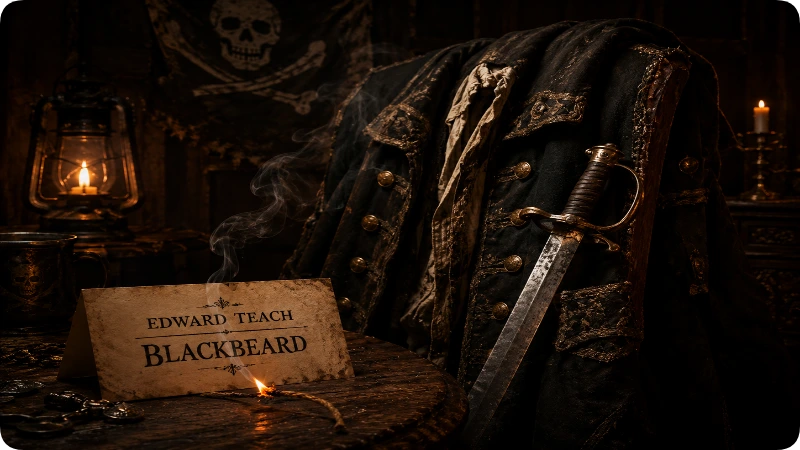
Blackbeard Edward Teach (c. 1680–1718)
No pirate name in history carries more immediate weight than Blackbeard. Born Edward Teach (sometimes spelled Thatch), he operated primarily in the Caribbean and along the American colonial coast between 1716 and 1718, a remarkably short active career for someone who achieved such extraordinary notoriety.
The name came from his most famous physical feature: a thick black beard that he wore long and reportedly tied with ribbons or hemp cord during battle. Contemporary accounts describe him weaving slowburning fuses into his beard during combat so that smoke would wreath his face creating a genuinely terrifying visual impression of a man emerging from hellfire.
This was a theater. Calculated, brilliant, deliberate theater. Blackbeard understood that fear was a more efficient weapon than violence that if his reputation preceded him effectively enough, he could take ships without firing a shot. He was, in modern terms, a master of psychological warfare and personal branding simultaneously.
He was killed in November 1718 in a battle off the coast of North Carolina, reportedly sustaining five gunshot wounds and around twenty sword cuts before finally going down. Even his death became legendary. His head was hung from the bowsprit of the naval vessel that killed him.
Name energy: Dark, overwhelming, elemental. Blackbeard doesn’t suggest a person so much as a force of nature that happened to wear a coat.
Calico Jack John Rackham (1682–1720)
The nickname “Calico Jack” came from John Rackham’s distinctive taste for calico (a brightly printed cotton fabric) clothing, an unusual affectation in an era of practical naval dress. He was, among pirates, something of a dandy.
Calico Jack is historically significant for several reasons beyond his own piracy. He is credited with designing the Jolly Roger flag variant featuring a skull with crossed swords one of the most recognizable symbols in visual history. He is also famous for his relationship with Anne Bonny, one of the most celebrated female pirates, and for the presence on his crew of Mary Read, another woman disguised as a man.
His end was ignominious. His crew was captured in October 1720 while most of them were drunk below decks. Anne Bonny’s reported last words to him were devastatingly on brand for their relationship: “If you had fought like a man, you need not have been hung like a dog.”
Name energy: Colorful, slightly flamboyant, unexpectedly stylish. Calico Jack is the pirate who cared about how he looked while doing it.
Anne Bonny (c. 1697 – after 1720)
Anne Bonny was born in Ireland, raised in the American colonies, and became one of the most celebrated female pirates of the Golden Age, which is remarkable given how thoroughly women were excluded from maritime life in that era.
She joined Calico Jack’s crew after leaving her first husband, disguised herself as a man alongside the equally remarkable Mary Read, and by contemporary accounts fought more ferociously than most of the male crew during the battle that ended their voyage. Her birth surname Bonny is irresistibly fitting in Irish English, “bonny” means attractive, lively, full of spirit. If that was coincidence or retrospective legendbuilding is impossible to say.
She was captured in 1720 but escaped execution by pleading pregnancy. Her fate after that point is genuinely unknown, one of history’s most intriguing open endings.
Name energy: Fire, independence, the specific courage of someone who refused the life assigned to them. Anne Bonny sounds like someone who made her own rules in an era that offered women almost none.
Mary Read (c. 1685–1721)
Mary Read’s story is extraordinary even by the standards of the Golden Age of Piracy. She had disguised herself as a man for most of her life working as a soldier, a sailor, and eventually a pirate aboard Calico Jack’s vessel. Her true identity was known to Anne Bonny and reportedly to Calico Jack, but remained hidden from the rest of the crew.
Contemporary accounts describe her as one of the most effective fighters on the ship which makes the circumstances of their capture (crew too drunk to fight) particularly pointed. She was captured alongside Anne Bonny in 1720, convicted of piracy, and died in prison in 1721, reportedly of fever.
Her name Read, suggesting both literacy and a past tense of “to read,” both interpretations fitting for someone whose entire life was a performance of a different identity carries a quiet, layered quality entirely different from the louder pirate names of her era.
Name energy: Complex, layered, quietly extraordinary. Mary Read sounds like someone with a story that keeps revealing new depths the more carefully you look.
Bartholomew Roberts Black Bart (1682–1722)
Bartholomew Roberts, known as Black Bart, has a strong claim to being the most successful pirate in the Golden Age of Piracy not the most famous, but arguably the most effective. By some estimates he captured over 400 ships during his career, a number that dwarfs most of his contemporaries.
Born in Wales, he came to piracy relatively late, having been captured by pirates himself in 1719. He rose quickly through ability rather than brutality; he was reportedly a teetotaler in an industry defined by drinking, a skilled navigator, and a genuine tactical intelligence. Black Bart created detailed articles (essentially a pirate constitution) governing behavior on his ships that were remarkably progressive for their era.
He was killed in battle in 1722, still wearing his signature red coat which may have contributed to his “Black Bart” nickname being a reference to his dark complexion rather than his clothing, though accounts differ.
Name energy: Efficient authority, dark competence, the quiet power of someone who didn’t need theatrics because the results spoke clearly enough.
Henry Every (c. 1659 – unknown)
Henry Every, also known as Long Ben or Henry Avery, pulled off what is widely considered the most profitable single act of piracy in history: the capture of the GanjiSawai, a Mughal treasure ship, in 1695. The ship was carrying enormous quantities of gold and silver along with passengers including members of the Mughal emperor’s court.
The raid triggered an international incident, prompted the first worldwide manhunt (with England offering a reward for his capture), and inspired plays, novels, and ballads during his own lifetime. He then vanished, his fate genuinely unknown, which may be the most pirate ending of all.
Name energy: Audacious, brilliant, and ultimately unknowable. Henry Every is history’s greatest exit, someone who achieved something extraordinary and then simply disappeared.
Grace O’Malley Gráinne Mhaol (c. 1530–1603)
Grace O’Malley predates the Golden Age of Piracy by a century but belongs in any serious discussion of famous pirate names because her story is simply too extraordinary to omit.
Born into a powerful Irish seafaring family, she became the chief of the O’Malley clan and controlled the waters off the west coast of Ireland for decades raiding ships, commanding fleets, and defying both English colonial authority and the social expectations of 16thcentury womanhood with equal thoroughness.
She reportedly met Queen Elizabeth I in 1593 to negotiate the release of her sons meeting a queen as an equal, conducting the conversation in Latin because neither spoke the other’s language. She is known in Irish tradition as “the pirate queen” and occupies a specific place in Irish cultural identity that has never faded.
Name energy: Ancient, fierce, deeply rooted. Grace O’Malley sounds like the sea itself changeable, powerful, and older than the laws that tried to contain her.
| Pirate Name | Active Era | Region | Famous For | Name Energy |
| Blackbeard | 1716–1718 | Caribbean/Atlantic | Psychological terror | Dark, overwhelming |
| Calico Jack | 1718–1720 | Caribbean | Jolly Roger design, Anne Bonny | Colorful, flamboyant |
| Anne Bonny | 1719–1720 | Caribbean | Female pirate, fierce fighter | Fiery, independent |
| Mary Read | 1719–1720 | Caribbean | Crossdressing, bravery | Complex, layered |
| Black Bart | 1719–1722 | Atlantic/Caribbean | 400+ ships captured | Dark authority |
| Henry Every | 1694–1696 | Indian Ocean | Greatest pirate raid | Audacious, elusive |
| Grace O’Malley | 1560s–1590s | Irish coasts | Pirate queen of Ireland | Ancient, fierce |
| William Kidd | 1696–1699 | Indian Ocean | Buried treasure legend | Ambiguous, tragic |
More Real Historical Pirates Worth Knowing
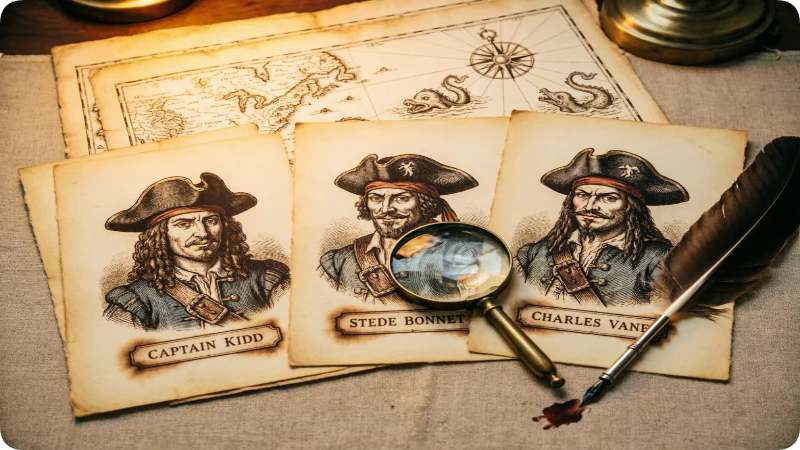
The Golden Age produced dozens of remarkable figures whose names deserve recognition beyond the famous few.
William Kidd Captain Kidd (c. 1655–1701)
Captain Kidd occupies one of history’s most genuinely ambiguous positions. He was a Scottish privateer legally licensed to attack enemy ships who was eventually tried and executed for piracy in circumstances that many historians consider deeply unjust. His case was likely a political sacrifice by the powerful men who had originally funded his privateering voyage.
The legend of Captain Kidd’s buried treasure has endured for over three centuries, inspiring countless expeditions, stories, and cultural references. Some treasure was actually found in a small cache recovered in 1699. If more exists remains genuinely unknown.
Name energy: Tragic ambiguity, the injustice of a man caught between legality and politics, and the eternal romance of buried treasure.
Bartholomew Sharp (c. 1650 – c. 1702)
One of the lesser-known but genuinely fascinating buccaneers of the late 17th century, Sharp led expeditions into the Pacific, an unusual theater for Caribbean-based pirates and captured a Spanish book of charts that proved enormously valuable to English navigation. He was tried for piracy but acquitted, partly because the charts he captured were considered so strategically valuable.
Charles Vane (c. 1680–1721)
One of the more genuinely brutal pirates of the Golden Age, Vane was known for his refusal of a royal pardon, a remarkable act of defiance when the British government was actively offering amnesty to pirates. He was eventually captured, tried, and executed. His name carries a sharp, cold quality entirely suited to his historical reputation.
Edward Low (c. 1690 – c. 1724)
Edward Low is documented as one of the most violent pirates of the Golden Age; his cruelty to captured crews was remarked upon even by the standards of an era not known for gentleness. His surname carries an ironic aptness that history occasionally provides.
Stede Bonnet The Gentleman Pirate (c. 1688–1718)
Stede Bonnet is one of history’s most fascinating footnotes. A wealthy Barbadian landowner, he purchased a ship and turned to piracy for reasons that contemporary accounts attributed to marital difficulties making him almost certainly the only person in history to have become a pirate to escape a difficult marriage.
He was an incompetent sailor who had to be repeatedly rescued by Blackbeard, whom he briefly partnered with. He was captured and executed in 1718. His story gained extraordinary new cultural attention through the HBO comedy series Our Flag Means Death (2022), which depicted his unlikely friendship with Blackbeard with warm, anarchic wit.
Name energy: Genteel chaos, accidental adventure, the endearing story of someone who had absolutely no business being where they ended up.
Famous Fictional Pirate Names That Defined the Mythology
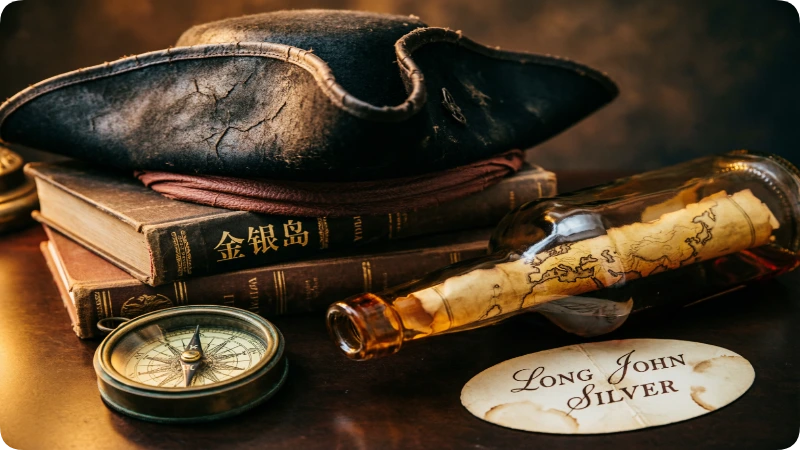
Historical pirates created the reality. Fictional pirates created the mythology that we now overlay onto history: the eye patches, the parrots, the “ARRR,” the buried treasure maps, the specific swaggering charisma. Understanding the fictional canon is essential to understanding why pirate names carry the cultural weight they do today.
Captain Jack Sparrow
Created by screenwriters Ted Elliott and Terry Rossio and brought to life by Johnny Depp in Pirates of the Caribbean (2003), Jack Sparrow is arguably the most influential fictional pirate of the 21st century.
The name is a masterpiece of construction. Sparrow, a small, unremarkable bird, suggesting something lightweight and possibly forgettable combined with the Captain title creates an immediate gap between expectation and reality that the character then spends five films navigating with idiosyncratic brilliance. He is never what you expect him to be. The name told you that from the beginning.
Depp modeled the character partly on Keith Richards, which gives Jack Sparrow a specific rock and droll charisma that traditional pirate portrayals lacked: unpredictable, charming, operating by his own internal logic that nobody else can quite follow.
Name energy: Deceptively lightweight, unexpectedly deep, the name of someone who will get out of this situation somehow and you genuinely cannot predict how.
Long John Silver
Robert Louis Stevenson created Long John Silver for Treasure Island (1883) and in doing so created what many consider the template for the fictional pirate. Silver is the ship’s cook, the leader of the pirate mutiny, and one of literature’s most genuinely complex antagonists: charming, intelligent, capable of real warmth, and ruthlessly selfinterested when circumstances require it.
The name is magnificent. Long John suggests both height and a certain informal grandiosity. Silver suggests treasure, value, something precious and metallic but also the second place metal, something that comes close to the best without quite reaching it. Jim Hawkins, the young narrator, genuinely likes Silver even knowing what he is. That moral ambiguity is written into the name.
Name energy: Warm authority with cold calculation underneath. The name of someone who will be your best friend right up until it’s more convenient not to be.
Captain Hook James Hook
J.M. Barrie’s Captain Hook from Peter Pan (1904) represents a specific archetype: the pirate as romantic villain, mourning something lost, defined by a single defining wound. The hook that replaced his hand taken by the crocodile, a detail that follows him with the ticking clock as a constant reminder of mortality is the character.
The surname Hook is therefore not a name at all; it’s a description, a wound made permanent, an identity built around loss. Captain Hook is a man who has reduced himself to his most defining injury and found a kind of dark dignity in it.
Name energy: Gothic, melancholy, the specific romanticism of someone who has built an identity around their damage.
Davy Jones
The origin of the phrase “Davy Jones’s locker” meaning the bottom of the sea, the fate of drowned sailors is genuinely uncertain, with several competing etymological theories. But Davy Jones as a character (particularly in Pirates of the Caribbean, where he is played by Bill Nighy) has become one of fiction’s most vivid embodiments of the sea’s cruelty and its strange supernatural authority.
The name is deceptively ordinary Davy (a diminutive of David, warm and accessible) combined with Jones (one of the most common Welsh surnames) which somehow makes the horror more effective. The most terrifying thing about the deep ocean is how indifferently ordinary its appetite is.
Name energy: Deceptively domestic, cosmically terrifying. The name of something ancient wearing a human face.
Captain Flint
The original Captain Flint in Treasure Island, the pirate whose buried treasure drives the entire plot never actually appears in the novel. He is dead before the story begins, existing only through other characters’ terrified memories and the treasure map he left behind.
That absence is everything. Captain Flint is the shadow the whole novel moves through, the gravitational center that never appears directly. His name Flint, suggesting the hard stone used to make fire, something that creates sparks but is itself cold and hard, carries exactly that quality of dangerous potential.
Name energy: Cold, hard, potentially explosive. The name of a legend everyone fears and nobody can fully see.
Other Iconic Fictional Pirates
- Captain Barbossa Pirates of the Caribbean’s Geoffrey Rushportrayed antagonistturnedally. The name has a Baroque European quality that suits his scheming, theatrical personality.
- Dread Pirate Roberts The Princess Bride (1987). The genius here is that the name is a franchise, not a person worn successively by different pirates, each inheriting the reputation. The name is transferable terror.
- Monkey D. Luffy One Piece’s rubberlimbed protagonist has the greatest pirate crew in anime history. His name suggests joy, chaos, and a rubber ball’s relationship with obstacles it bounces off everything.
- Captain Harlock Leiji Matsumoto’s Space Pirate Captain Harlock (1977) represents a specifically Japanese interpretation of pirate mythology: the lone rebel against corrupt authority, romantic and tragic, sailing through space rather than water. The name carries that solitary grandeur.
Pirate Naming Traditions and What Made Them Distinctive
The Epithet Tradition
Most famous pirate nicknames were descriptive epithets based on appearance, behavior, or reputation:
- Blackbeard appearance (black beard)
- Black Bart appearance (dark complexion) or behavior
- Calico Jack clothing preference (calico fabric)
- Long Ben (Henry Every) appearance (tall)
- Red Beard Various pirates used this across different eras
The pattern: a color or adjective plus a physical feature or name. Simple, visual, immediately communicative. These names worked in an era before photographs because they created instant mental pictures that spread accurately through word of mouth.
The Captain Title
The captain title in pirate culture was both more democratic and more absolute than in the Royal Navy. The title Captain therefore carried earned authority rather than appointed rank, which gives it a different weight in pirate naming than in military contexts.
Women Who Claimed Male Names
Anne Bonny and Mary Read both operated under their own names which required extraordinary courage given the penalties for women found aboard pirate vessels. Other women in maritime history adopted male names entirely. This tradition of claiming or constructing an identity through naming runs through pirate culture from the 17th century to contemporary drag and cosplay communities in ways that feel surprisingly continuous.
Regional Naming Traditions
- Caribbean buccaneers Often had French, Dutch, or English names reflecting the multinational chaos of Caribbean colonialism
- Barbary Coast pirates North African corsairs operated under entirely different naming traditions, with Arabic names and titles
- East Asian pirates Figures like Ching Shih (who commanded a fleet of 1,800 ships in early 19th century China) operated within Chinese naming conventions that differ entirely from European pirate naming
- Irish maritime tradition Grace O’Malley’s name exists in both Irish (Gráinne Mhaol) and English forms, reflecting the colonial translation that many Irish names underwent
Famous Pirate Names From Global Traditions
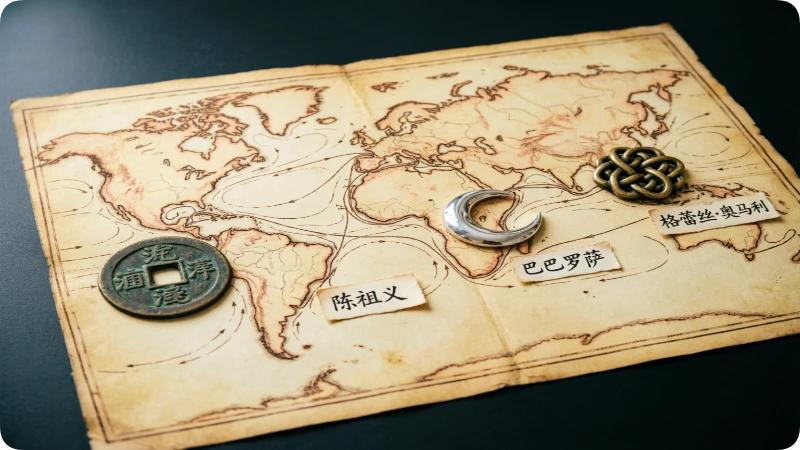
European and Caribbean pirates dominate most famous pirate lists but maritime raiding was a global phenomenon with extraordinary figures in every ocean tradition.
Ching Shih (c. 1775–1844)
Ching Shih also wrote Zheng Yi Sao, meaning “wife of Zheng Yi” was a Chinese pirate commander who by some accounts controlled the largest pirate confederation in history. At the height of her power she commanded around 1,800 vessels and 80,000 sailors, operated a sophisticated taxation system on coastal villages, and maintained a code of conduct among her crews that included protections for female captives.
She was so powerful that the Chinese imperial government, the British Empire, and the Portuguese Empire all failed to defeat her. Later, she eventually negotiated a peaceful retirement on favorable terms keeping most of her wealth and lived to old age running a gambling establishment. She is arguably the most successful pirate who ever lived by any objective measure.
Name energy: Administrative authority, enormous scale, and the specific power of someone who built a genuine empire from outside every legitimate structure.
Hayreddin Barbarossa (c. 1478–1546)
The name Barbarossa means “red beard” in Italian connecting him to the same epithet tradition as his European pirate counterparts, despite operating in an entirely different cultural context. Hayreddin Barbarossa was an Ottoman admiral and former pirate who became one of the most powerful naval commanders of the 16th century Mediterranean.
The question of what separates a pirate from an admiral is one that his biography asks with particular sharpness.
Zheng Chenggong Koxinga (1624–1662)
A ChineseJapanese military commander who controlled maritime trade and conducted what contemporaries considered piracy across the South China Sea, Koxinga is one of history’s most complex figures simultaneously a pirate, a loyalist military commander, and a national hero in both China and Taiwan. His name means “Lord of the Imperial Surname,” reflecting his claimed legitimacy even as his methods were anything but conventional.
Pirate Names in Modern Culture and Why They Keep Coming Back
Three centuries after the Golden Age of Piracy, pirate names continue to generate extraordinary cultural resonance and the reasons are worth examining.
The Ongoing Pop Culture Revival
The Pirates of the Caribbean franchise (2003–2017) introduced pirate aesthetics to an entirely new generation, but the revival didn’t stop there. Our Flag Means Death (2022) brought a queer, tender, genuinely funny interpretation of Blackbeard and Stede Bonnet’s relationship to HBO audiences who’d never previously considered pirate history. One Piece, the longest-running manga and anime series in history, has built the world’s most elaborate fictional pirate mythology over decades, with a passionate global fandom that continues to grow.
On TikTok and Pinterest, pirate aesthetics intersect with dark academia, cottagecore, and maritime vintage trends in ways that keep the imagery perpetually current. The specific visual vocabulary of piracy the ship, the skull, the compass, the sea chart has become a stable aesthetic shorthand for freedom, rebellion, and a certain romantic indifference to authority.
Why We’re Still Naming Things After Pirates
Baby name forums show consistent interest in pirate-adjacent names, not usually the famous pirate names themselves, but names with the same energy: Morgan (Sir Henry Morgan, the buccaneerturnedGovernor), Drake (Sir Francis Drake, privateer and circumnavigator), Raleigh, Hawkins. Names that carry maritime authority and a certain frontier boldness.
In gaming, pirate names remain enduringly popular for characters with Blackbeard, Bartholomew, Calico, and Bonny all appearing frequently in character naming discussions.
In fiction, the pirate name tradition continues to generate extraordinary creativity combining the historical naming patterns (epithets, captain titles, visual descriptors) with fantasy and scifi elements to create names that feel simultaneously rooted and invented.
Top 10 Most Famous Pirates of All Time
If you’re looking for the most famous pirate names ever recorded in history and popular culture, these ten names consistently rank among the best known worldwide:
- Blackbeard – The most feared pirate of the Golden Age and arguably the most famous pirate in history.
- Anne Bonny – One of history’s most celebrated female pirates.
- Mary Read – A legendary female pirate who disguised herself as a man.
- Bartholomew Roberts – The most successful pirate by number of ships captured.
- Henry Every – Famous for carrying out one of the richest pirate raids ever recorded.
- William Kidd – The pirate whose buried treasure legend has survived for centuries.
- Grace O’Malley – Ireland’s legendary pirate queen and naval commander.
- Ching Shih – The most successful female pirate commander in world history.
- Captain Jack Sparrow – The most famous fictional pirate of the modern era.
- Long John Silver – The character who defined the classic pirate archetype.
Depending on whether you prioritize historical influence, cultural recognition, military success, or fictional popularity, the exact ranking may vary. However, these ten pirate names remain the most recognizable across history, literature, film, and popular culture.
Frequently Asked Questions
Who was the most famous real pirate in history?
Blackbeard (Edward Teach) is the most famous pirate in history by almost any measure of cultural recognition. However, Bartholomew Roberts (Black Bart) captured the most ships, Ching Shih commanded the largest fleet, and Henry Every pulled off the most profitable single act of piracy. Fame, success, and notoriety point to different individuals which is part of what makes pirate history so genuinely interesting.
What is the most famous pirate name of all time?
Blackbeard is almost certainly the most recognizable pirate name globally, followed by Captain Jack Sparrow (fictional) and Long John Silver (fictional). Among real pirates, Anne Bonny has achieved extraordinary cultural resurgence in recent decades, particularly among feminist historians and in popular media.
Were there real female pirates?
Some documented female pirates include Anne Bonny, Mary Read (both active in the Caribbean in 1719–1720), and Grace O’Malley (Ireland, 16th century). The most successful female pirate commander in history was Ching Shih of China, who commanded fleets far larger than any of her European male contemporaries. The historical record almost certainly undercounts female pirates, given the era’s systematic erasure of women from official documentation.
What does “Davy Jones’s Locker” actually mean?
Davy Jones’s Locker refers to the bottom of the ocean, the fate of drowned sailors and sunken ships. As a fictional character, Davy Jones represents the sea’s appetite for human life, the personification of the ocean’s indifference to human survival.
What was Jolly Roger?
The Jolly Roger is the name for a pirate flag, most famously depicting a skull and crossbones. Different pirate captains flew different variants. Calico Jack’s version featured a skull with crossed swords rather than bones. Blackbeard’s flag reportedly showed a skeleton holding an hourglass and spearing a heart. The flags were designed to be recognized from a distance and to signal a specific message: surrender now or expect no mercy.
Why are pirate names so memorable?
Pirate names tend to be memorable because many were deliberately constructed for psychological impact rather than simply inherited. They often combined vivid visual imagery (Blackbeard, Calico Jack) with simple, punchy construction. They were spread through oral tradition repeated in terrified port conversations, naval reports, and popular ballads which were selected for names that were easy to say, easy to remember, and impossible to misunderstand.
What are good pirate names?
Good pirate names usually combine strong imagery, memorable sounds, and a sense of adventure or danger. Historical examples include Blackbeard, Calico Jack, Anne Bonny, Black Bart, and Captain Kidd. Fictional favorites include Captain Jack Sparrow, Long John Silver, Captain Hook, Davy Jones, and Captain Flint.
If you’re looking for pirate-inspired names for characters, games, costumes, or events, some popular options include:
- Blackbeard
- Calico Jack
- Black Bart
- Captain Flint
- Captain Jack Sparrow
- Long John Silver
- Captain Hook
- Davy Jones
- Anne Bonny
- Mary Read
- Grace O’Malley
- Ching Shih
- Henry Every
- Charles Vane
- Stede Bonnet
These names remain popular because they combine history, mythology, rebellion, adventure, and unforgettable storytelling into a single identity.
The Names That Refused to Drown
History drowns most things. Ships rot. Documents burn. Empires collapse. The specific details of ordinary lives, the names, the faces, the particular quality of a Tuesday afternoon three hundred years ago sink without trace.
But these names didn’t sink.
Blackbeard. Anne Bonny. Grace O’Malley. Long John Silver. Jack Sparrow. Captain Hook. They’re as alive today as they were in the moments that made them, which tells you something important about what a name can do when it carries the right combination of story, symbol, and sheer human nerve.
The historical pirates understood something that the best namers in any tradition understand: a name is not a label. It’s a declaration. It announces who you have decided to be, what you are capable of, and what the world should expect when you appear on the horizon.
Blackbeard didn’t name himself for identification. He named himself for effect. He named himself to make captains surrender before a single shot was fired.
That ambition to have a name that does real work in the world, that carries weight, that arrives before you do and lingers after you leave is something human beings have always understood.
These pirates just happened to pursue it on the open water, under a skull-and-crossbones flag, three centuries ago.
And somehow, impossibly, beautifully their names are still sailing.

I am Clara Bennett, a passionate Name Researcher and Content Writer at Nameopediahub.com . I share well-researched content about name meanings, origins, trends, and naming ideas to help readers discover unique and meaningful names from around the world. nameopediahub.com