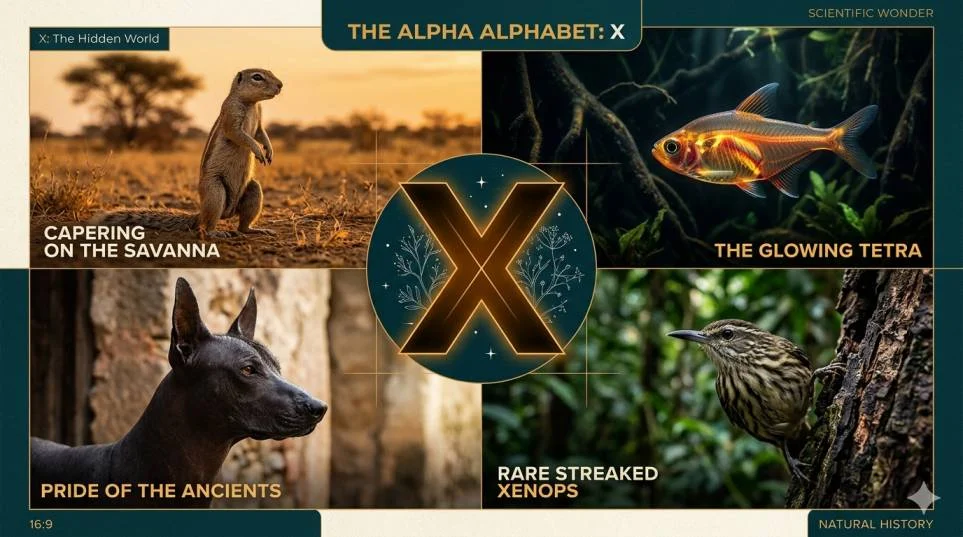
There’s something about the letter X that makes everything feel more mysterious. Like a buried map coordinate, or the name of a creature that shouldn’t quite exist but does.
Animals that start with X are genuinely rare in the alphabet of the animal kingdom. Most people can name a dozen animals starting with A without blinking.
Ask them to name three starting with X and you watch the pause happen. The mental flip through the files. The slow uncertain “…Xerus?”
But here’s what that pause misses: X animals are some of the most fascinating creatures on the planet. Ancient fish that look like they predate dinosaurs. Butterflies with wings like stained glass.
Monkeys that scientists only formally confirmed this century. A desert squirrel so specialised it can survive conditions that would kill most mammals.
Whether you’re a student working on a school project, a wildlife lover building a complete alphabet of animals, a trivia enthusiast, or a parent helping a curious child this is the most complete and genuinely interesting guide to animals that start with X you’ll find anywhere.
Quick Answer:
Animals that start with X include the Xerus (African ground squirrel), X-ray Tetra (transparent freshwater fish), Xoloitzcuintli (ancient Mexican hairless dog), Xenops (South American bird), Xenopus (African clawed frog), Xantus’s Hummingbird, Xiphias (swordfish genus), Xenarthra (superorder including sloths and armadillos), and the Xolmis (a South American flycatcher bird).
There are also extinct species like Xiaosaurus and Xenoceratops both dinosaurs beginning with X.
Animals Beginning With X
Your complete A-to-X field guide for the rarest letter in the animal kingdom
| Animal | Type | Where Found | Fast Fact |
| Xerus | Mammal | Africa | Ground squirrel that uses its tail as a sun umbrella |
| X-ray Tetra | Fish | South America | Transparent skin reveals its spine and organs |
| Xoloitzcuintli | Dog breed | Mexico | One of the oldest and rarest dog breeds on Earth |
| Xenops | Bird | Central/South America | Climbs bark upside-down like a tiny detective |
| Xenopus | Amphibian | Sub-Saharan Africa | Used in early human pregnancy tests |
| Xantus’s Hummingbird | Bird | Mexico (Baja) | Found nowhere else on Earth |
| Xiphias | Fish | Global oceans | The genus name for the Atlantic swordfish |
| Xolmis | Bird | South America | Elegant flycatcher of open grasslands |
| Xenarthra | Superorder | Americas | Includes sloths, armadillos, and anteaters |
| Xiaosaurus | Dinosaur (extinct) | China | Small, nimble Jurassic herbivore |
| Xenoceratops | Dinosaur (extinct) | Canada | Horned dinosaur older than Triceratops |
| Xeme | Bird | Arctic | Also called the sabine’s gull; migrates impossibly far |
Mammals Start With X
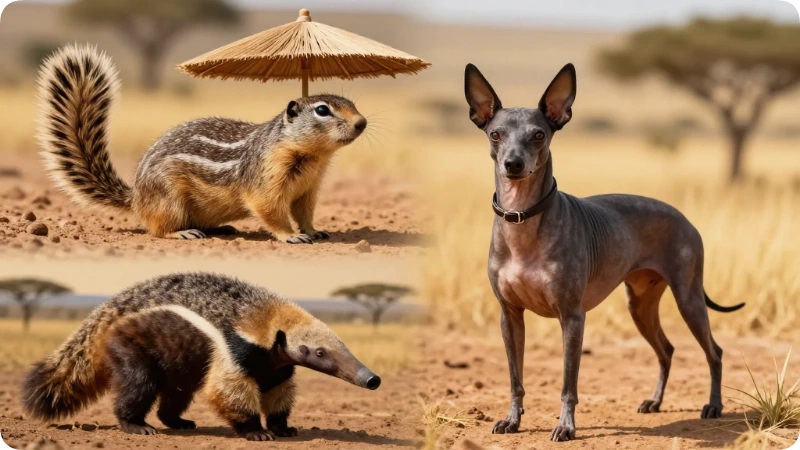
From desert survivalists to ancient dogs the mammals of X are nothing short of extraordinary
Mammals beginning with X are a short but deeply fascinating group. What they lack in number they make up for in sheer strangeness a hairless ancient dog worshipped by civilisations that no longer exist, a squirrel that treats the Kalahari like a backyard, a superorder of animals so anatomically unusual that scientists gave them their own branch of the mammal family tree.
Xerus The Desert Squirrel With a Built-In Parasol
The Xerus is an African ground squirrel found across the dry savannas and semi-arid regions of sub-Saharan Africa. Unlike its tree-dwelling squirrel relatives, the Xerus lives in burrows, is fully terrestrial, and has evolved for extreme heat in ways that feel almost sci-fi.
Its most remarkable adaptation: it uses its own bushy tail as a sun umbrella. When the temperature climbs to dangerous levels, a Xerus will flip its tail forward over its body to create shade, reducing its heat load significantly. It has also been observed using the same tail-parasol behaviour to look bigger when confronting predators elegant engineering serving two purposes at once.
There are four species of Xerus the Cape Ground Squirrel, the Unstriped Ground Squirrel, the Striped Ground Squirrel, and the Mountain Ground Squirrel each adapted to slightly different African environments. They are highly social animals that live in colonies, with females often raising pups cooperatively. In Zimbabwe and Botswana they are common enough to be a familiar sight, but in most of the world they remain unknown.
For trivia lovers: the Xerus is closely related to the marmot and the prairie dog North America’s most sociable burrowing mammals.
Xoloitzcuintli The Dog That Lived Through Civilisations
Say it slowly: show-low-eats-QUEENT-lee. Also called the Mexican Hairless Dog or simply the Xolo, this is one of the oldest dog breeds in the world and almost certainly the oldest in the Americas.
The Xoloitzcuintli has been part of Mesoamerican culture for over 3,000 years. The Aztecs considered the Xolo a sacred guide who could lead human souls through the underworld. The dog’s name itself comes from Xolotl the Aztec god of lightning and death and itzcuintli, the Nahuatl word for dog. So the Xoloitzcuintli is literally the Dog of the God of Death. Which is either deeply unsettling or extremely cool, depending on your aesthetic.
The breed nearly went extinct in the 20th century. By the 1950s, population numbers had fallen so dramatically that the Mexican Kennel Club organised an expedition into remote Mexican villages to locate surviving dogs. They found enough to revive the breed. The Xolo is now Mexico’s national dog.
It appears famously in Pixar’s Coco as Dante Miguel’s spirit guide which introduced the breed to an entirely new global generation.
The Xolo comes in three sizes (toy, miniature, standard) and two varieties (hairless and coated). Its hairless skin is warm to the touch, which led to the folk belief that sleeping with a Xolo could cure arthritis and rheumatism. Whether or not that’s medically accurate, it does make for an extraordinarily warm lapdog.
Xenarthra The Superorder That Includes Sloths
Xenarthra isn’t a single animal it’s an entire superorder of mammals, one of the most ancient and distinctive branches of the mammal family tree. The name means “strange joints” in Greek, referring to the extra articulations in their vertebrae that no other mammals have.
The Xenarthra includes three living orders: the sloths (Pilosa), the anteaters (also Pilosa), and the armadillos (Cingulata). Every sloth you’ve ever seen, every giant anteater plodding across a Brazilian grassland, every armadillo curling into a ball on a Texas roadside all Xenarthra.
What makes this group remarkable is how early they diverged from other mammals. Xenarthra split from the rest of the placental mammals somewhere between 90 and 100 million years ago, evolving almost entirely in South America during a period when that continent was an island. The result is a group of animals with metabolisms, bone structures, and anatomies that look like evolution experimenting with a completely different set of rules.
Birds That Start With X
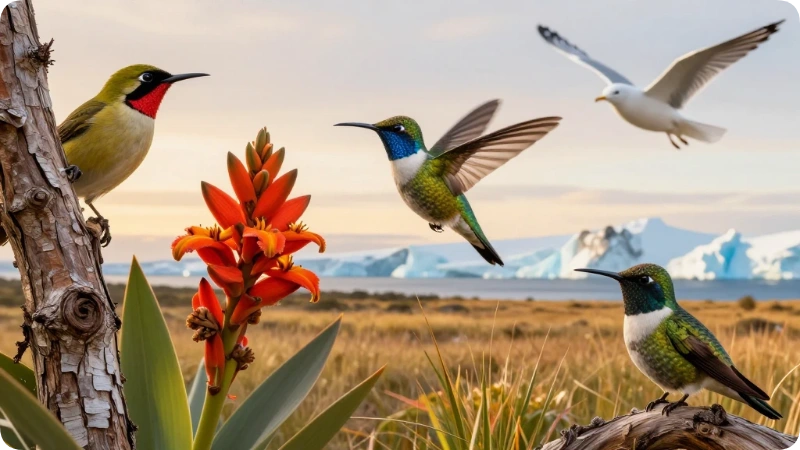
Small, spectacular, and startlingly overlooked the X birds of the world are worth knowing
Birds beginning with X are almost all found in the Americas and they have a quiet brilliance about them. They’re not the flashy tropical birds that dominate wildlife documentaries. They’re the specialist species, the ones that evolved for very specific ecological roles and do those roles with extraordinary precision.
Xenops The Bark Detective
The Xenops is a small, unassuming bird found across Central and South America, belonging to the ovenbird family Furnariidae. There are several species the Plain Xenops, the Streaked Xenops, the Slender-billed Xenops and they all share the same extraordinary hunting strategy.
The Xenops forages for insects by climbing along branches and bark in a manner resembling a nuthatch or treecreeper often working upside-down along the underside of branches. Its bill has a distinctive upturned tip, perfectly shaped for prying apart bark and probing crevices. It finds food that other birds literally cannot access.
It’s the kind of bird that rewards careful attention. Easy to overlook. Extraordinary once seen properly.
Xantus’s Hummingbird The Endemic Jewel
Xantus’s Hummingbird (Basilinna xantusii) is found only on the Baja California peninsula of Mexico one of the most range-restricted hummingbirds in North America. Named after the Hungarian zoologist John Xantus de Vesey, who collected specimens in Baja in the 1850s, this bird is a study in emerald and rufous, with a distinctive white stripe behind the eye.
It’s a genuine endemic a species that exists in one place and nowhere else on Earth. That geographic specificity makes it a priority target for birdwatchers visiting Baja, one of those species where the journey to see it becomes part of the experience.
Xolmis The Elegant Grassland Hunter
Xolmis is a genus of tyrant flycatchers found across South America, particularly in open grasslands, shrublands, and agricultural areas. Species like the White Monjita (Xolmis irupero) are strikingly beautiful clean white plumage, black wingtips, the kind of graphic simplicity that looks almost designed.
They hunt from exposed perches, launching into short aerial sallies to catch insects in flight. Calm, precise, and visually striking the Xolmis is one of those birds that makes South American grasslands feel like they belong in a different world.
Xeme The Arctic Wanderer
The Xeme, better known as the Sabine’s Gull (Xema sabini), is a small, delicate gull of the high Arctic. It breeds in the Arctic tundra and then migrates impossibly, beautifully to the coasts of West Africa and South America for winter. Seeing one off a storm-battered Atlantic headland during autumn migration is considered a genuine highlight by serious birdwatchers.
Its tricoloured wing pattern grey, black, and white makes it unmistakable. The name Xeme comes from a Greenlandic word for the species.
Fish That Start With X
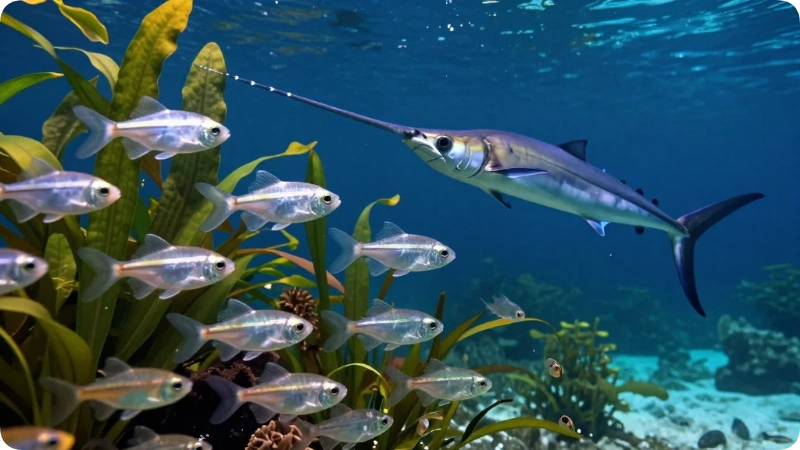
Glass-bodied river fish and ocean hunters the aquatic world’s most fascinating X creatures
X-ray Tetra The Transparent Fish
The X-ray Tetra (Pristella maxillaris) is one of the most visually extraordinary freshwater fish in existence. Its body is nearly completely transparent you can see its spine, its internal organs, even the shadow of its swim bladder through its skin. The effect, especially in a well-lit aquarium, is somewhere between a biological specimen and a living piece of glass art.
Despite this vulnerability-inducing transparency, the X-ray Tetra is a robust and adaptable fish. It’s native to the coastal rivers of Venezuela, Guyana, and the Amazon basin, where it lives in schools of hundreds in slightly brackish or freshwater environments. The transparency is thought to make it harder for predators to target individual fish within a shoal safety through invisibility.
In the aquarium hobby, the X-ray Tetra is a long-standing favourite. It’s peaceful, easy to keep, visually striking, and does well in community tanks. The fins carry a distinctive black-and-white-and-yellow pattern that becomes more vivid against the transparent body like a frame around a window.
Xiphias The Swordfish
Normal, reader-friendly version:
Xiphias gladius, better known as the swordfish, is one of the ocean’s most recognizable fish. Its scientific name comes from the Greek and Latin words for “sword,” a reference to the fish’s long, pointed bill. This impressive weapon can grow to around 3 metres (10 feet) in length and is used to slash through schools of fish while hunting. Swordfish are also incredibly fast swimmers, reaching speeds of up to 97 km/h (60 mph), making them one of the ocean’s top predators.
The swordfish is a highly migratory pelagic fish found in tropical and temperate oceans worldwide. It is one of the fastest fish in the sea, with a specialised body temperature regulation system it can warm its brain and eyes independently from its body temperature, allowing it to hunt effectively in deep cold water where prey is abundant.
Animals That Start With X for Kids
If you’re teaching children about animals beginning with X, some of the easiest and most memorable examples are the Xerus, X-ray Tetra, Xoloitzcuintli, Xenops, and Xenopus. These animals are fascinating because each has a unique feature children can easily remember. The Xerus uses its tail like an umbrella, the X-ray Tetra has a transparent body, and the Xoloitzcuintli is an ancient Mexican dog breed made famous by Pixar’s Coco.
These X animals are excellent choices for school projects, alphabet lessons, and early science activities because they combine unusual names with interesting facts that make learning fun.
Reptiles & Amphibians That Start With X
Xenopus The Frog That Changed Medicine
The Xenopus is a genus of African clawed frogs flat-bodied, fully aquatic frogs native to sub-Saharan Africa. They’re not conventionally beautiful. They have no tongue, no visible eardrum, no eyelids. They move through water with a slightly alien efficiency, their small clawed hind feet raking through mud for food.
But the Xenopus laevis the African Clawed Frog holds one of the most surprising places in the history of human medicine.
From the 1930s through to the 1960s, Xenopus frogs were used as a living pregnancy test. When injected with the urine of a pregnant woman (which contains the hormone hCG), a female Xenopus would lay eggs within 12 hours. The test called the Hogben test was the first reliable pregnancy test available in the era before modern chemical diagnostics. Hospitals worldwide kept tanks of Xenopus frogs for exactly this purpose.
The Xenopus remains one of the most important research animals in modern biology. Its large, easily manipulated eggs have made it invaluable for studying developmental biology, genetics, and cell biology. Much of what we know about how vertebrate embryos develop was first worked out in Xenopus eggs.
It is also, unfortunately, one of the animals responsible for spreading the chytrid fungus (Batrachochytrium dendrobatidis) a pathogen that has devastated amphibian populations worldwide. Because Xenopus frogs carry the fungus without dying from it, the global trade in lab frogs throughout the 20th century inadvertently spread chytrid to environments where native amphibians had no resistance.
Xenodermus The Dragon Snake
The Xenodermus javanicus, or Dragon Snake, is a small, strikingly unusual snake found in the lowland forests of Myanmar, Thailand, Malaysia, and Indonesia. Its dorsal scales are raised and keeled in three distinct rows, giving it a ridged, almost reptilian-fantasy appearance it genuinely looks like a miniature dragon.
The Dragon Snake is secretive and poorly understood. It feeds on frogs and small fish in wet forest environments near streams. It’s known to stiffen its body completely when handled a defensive behaviour unlike anything seen in most snakes. Currently listed as vulnerable, it does not survive well in captivity, which means scientific study has been limited.
Insects & Invertebrates That Start With X
The smallest X creatures, and some of the most beautiful.
Xestia The Gothic Moths
Xestia is a large genus of moths in the family Noctuidae the owlet moths. Species like Xestia c-nigrum (the Setaceous Hebrew Character) are found across Europe, Asia, and North America, and are notable for the bold, almost calligraphic marking on their forewings.
The name Xestia comes from the Greek for “polished” or “scraped smooth.” Many Xestia species are agricultural pests, but as moths go, they’re genuinely attractive subtle, complex patterning in earth tones that only reveals itself under close inspection.
Xylocopa The Carpenter Bees
Xylocopa is the genus of carpenter bees large, solitary bees found worldwide that nest by boring perfectly circular holes into dry wood. The name comes from the Greek xylokopos, meaning “wood-cutter.”
Carpenter bees are among the most important pollinators in many ecosystems, and their hovering, investigating behaviour makes them feel curious and almost personable. The females are capable of stinging but are docile; the males are completely harmless but aggressively territorial they will hover directly in front of a human face to investigate, which feels alarming but is entirely theatre.
Xerces Blue The First American Butterfly to Go Extinct
The Xerces Blue (Glaucopsyche xerces) was a butterfly found only on the San Francisco Peninsula in California. It was declared extinct in 1943 the first butterfly in the United States to go extinct due to human activity, specifically the destruction of its coastal dune habitat as the city of San Francisco expanded.
Its extinction prompted one of the first organised insect conservation efforts in American history. The Xerces Society a nonprofit organisation dedicated to invertebrate conservation was named in its honour in 1971 and remains one of the leading invertebrate conservation organisations in the world.
The Xerces Blue is a haunting symbol of what is lost when habitat disappears. It existed within the boundaries of a single city. Nobody saved a specimen while it still lived. The last known individual was collected in 1943, and then there were none.
Extinct Animals That Start With X
Dinosaurs That Start With X
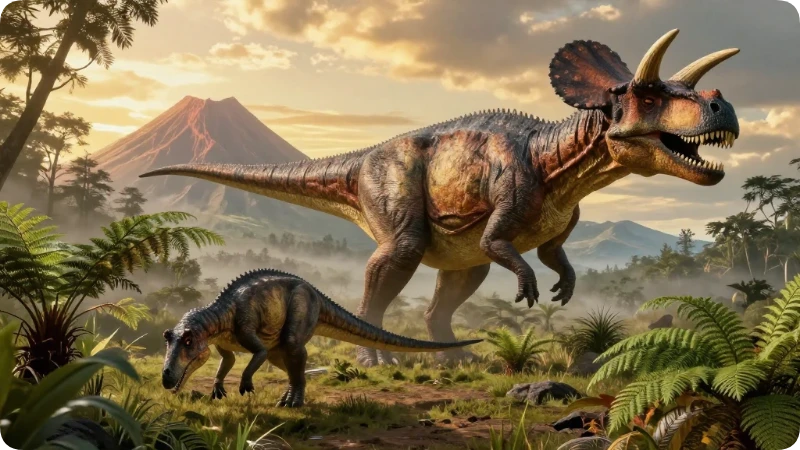
If you’re looking for dinosaurs that start with X, the two best-known examples are Xiao saurus and X e nocer a tops. While dinosaur names beginning with X are extremely rare, these prehistoric species show that the letter X has a place in the fossil record too.
Xiaosaurus was a small plant-eating dinosaur that lived during the Middle Jurassic period in what is now China. Its name means “little lizard,” and it was likely a fast-moving herbivore that survived by avoiding larger predators.
Xenoceratops was a horned dinosaur discovered in Alberta, Canada. Living around 80 million years ago, it is one of the oldest known large ceratopsians in North America and predates the famous Triceratops by millions of years.
Because relatively few dinosaur genera begin with the letter X, Xiaosaurus and Xenoceratops are the most commonly cited answers for searches such as “dinosaurs names beginning with X,” “dinosaurs that start with X,” and “dinosaurs beginning with the letter X.”
Dinosaurs, lost species, and creatures that once ruled the world
Xiaosaurus The Little Lizard of the Jurassic
Xiaosaurus dashanpensis was a small ornithopod dinosaur from the Middle Jurassic period, discovered in the Dashanpu Formation of Sichuan Province, China. The name means “little lizard” which is almost aggressively modest for an animal that lived 165 million years ago.
It was bipedal, lightly built, and probably fast a small herbivore that would have moved in a world shared with much larger sauropods and early predators. Not a glamorous dinosaur. Not one that appears on the cover of dinosaur books. But 165 million years of existence feels like it deserves a mention.
Xenoceratops The Horned Face Before Triceratops
Xenoceratops foremostensis was discovered in Alberta, Canada, and described to science in 2012. It lived approximately 80 million years ago nearly 15 million years before Triceratops making it one of the oldest large-bodied horned dinosaurs (ceratopsids) known from North America.
Its name means “alien horned face from Foremost” a reference to both its unusual horn arrangement and the Foremost Formation in Alberta where it was found.
Xenoceratops is a reminder of how incomplete our picture of the Mesozoic world remains. A genus-level ceratopsid from a well-studied fossil bed, undescribed until 2012.
Ocean Animals That Start With X
Although animals beginning with X are already rare, marine species are even harder to find. The most famous ocean animal that starts with X is Xiphias gladius, better known as the swordfish, one of the fastest predators in the sea. Other examples include Xenoconger, a marine eel, and Xenophyophores, giant single-celled organisms that live in the deep ocean. These species highlight the surprising diversity of X animals beneath the waves while showing that the letter X appears more often in scientific names than common English names.
Frequently Asked Questions
What is the most famous animal that starts with X?
The most widely known animal starting with X is probably the Xoloitzcuintli (Mexican Hairless Dog), thanks to its starring role in Pixar’s Coco as the dog Dante. Among wild animals, the X-ray Tetra is the most recognised, being a staple of aquarium shops worldwide. In terms of cultural name recognition, Xerus is the most commonly cited in educational settings.
Are there any big animals that start with X?
The largest animals starting with X depend on your category. Among fish, Xiphias (the swordfish) can reach up to 4.5 metres in length and weigh over 650 kg. The Xenarthra superorder, the Giant Anteater reaches 2.1 metres. Among extinct species, Xenoceratops would have been comparable in size to other large ceratopsid dinosaurs roughly the size of a large rhinoceros.
What animals starting with X are good for kids to learn?
The best X animals for children’s education are the X-ray Tetra (visually fascinating and easy to explain), the Xerus (fun tail-umbrella adaptation), the Xoloitzcuintli (great story and pop culture hook via Coco), and Xenopus (the pregnancy test frog is genuinely surprising and memorable). Each has a vivid, engaging hook that makes them easy to remember.
Is Xolo a real dog breed or just from Coco?
The Xoloitzcuintli is absolutely a real dog breed one of the oldest and rarest in the world. Pixar’s Coco used the breed very deliberately as Miguel’s spirit guide because of the Xolo’s real historical significance in Aztec culture as a psychopomp a guide for souls in the afterlife. The film dramatically increased public awareness of and interest in the breed.
What is a small animal that starts with X?
The Xenops bird is one of the smallest a compact, sparrow-sized bird of tropical forests. The X-ray Tetra typically reaches only 4–5 cm in length. Among insects, Xylocopa (carpenter bees) are notably large for bees but still small by most animal standards. The Xeme (Sabine’s Gull) is considered a small gull species.
Are there any dangerous animals starting with X?
None of the living X animals are considered highly dangerous to humans. The swordfish (Xiphias) has been known to ram boats and has injured fishermen, and its bill is capable of puncturing boat hulls. The Xenopus frog is implicated in spreading chytrid fungus, which is catastrophic for global amphibian biodiversity though not dangerous to humans directly.
What Is the X-Ray Fish Called?
The most famous fish beginning with X is the X-ray Tetra (Pristella maxillaris). This small freshwater fish gets its name from its transparent body, which allows its spine and internal organs to be seen through the skin. Native to South America, the X-ray Tetra is popular in home aquariums because it is peaceful, hardy, and visually striking.
What Animals Start With X in Spanish?
Animal names beginning with X are rare in Spanish, just as they are in English. One well-known example is the Xoloitzcuintle, the Mexican Hairless Dog, whose name comes from the Nahuatl language and is widely used in Spanish-speaking countries. Other animals are usually known by their scientific names beginning with X, such as Xenopus and Xerus.
What Animals Start With X in German?
Very few common German animal names begin with X. German speakers often use international or scientific names such as Xerus, Xenopus, Xylocopa, and Xoloitzcuintli.
What ocean animals start with X?
Several ocean animals begin with the letter X, with the best-known example being Xiphias gladius, the swordfish. Other marine animals with X names include Xenophyophores, giant deep-sea single-celled organisms found on the ocean floor, and Xenoconger, a genus of marine conger eels. Among these, the swordfish is by far the most recognizable ocean animal that starts with X.
Are there any animals that start with XYZ?
No. There are no officially recognized animal names that begin with the sequence XYZ. People usually search this phrase while looking for unusual alphabet animals, but the closest real examples are animals beginning with X, such as the Xerus, X-ray Tetra, Xenops, Xenopus, and Xoloitzcuintli.
Why X Animals Matter More Than the Alphabet Suggests
The letter X turns up rarely in English animal names for the same reason it turns up rarely in English words it’s a borrowed letter, doing double duty between the sounds of Z and KS, usually found in words inherited from Greek or Nahuatl or constructed by 19th-century taxonomists with a fondness for classical languages.
But the animals themselves don’t care about that. The Xerus didn’t choose its name. The Xenopus changed medicine without knowing it. The Xerces Blue went extinct before most of the people who named it were born.
What these animals share isn’t an accident of alphabetical assignment. It’s something more interesting they’re all at the edges. The edge of a desert, forest,what we know,survival.
The X animals are worth knowing precisely because they’re overlooked. Because when you know what a Xenops does with its bill, or why the Xoloitzcuintli was sacred, or how a transparent fish manages to survive in predator-rich waters, you’ve learned something that most people around you haven’t.

I am Olivia Hayes, a dedicated Name Researcher and Content Writer at NameopediaHub.com. I create engaging and well-researched content about name meanings, origins, trends, and unique naming ideas to help readers explore the fascinating world of names. nameopediahub.com