Ask anyone on the planet to name the Seven Dwarfs and watch what happens.
They’ll get four or five immediately Doc, Grumpy, Happy, Sleepy then slow down, furrow their brow, and start second guessing themselves. Is it Sneezy or Bashful first? Wait, is Dopey actually one of them?
And somewhere in the pause between names five and six, they’ll feel a slightly embarrassing but entirely genuine emotional tug toward a group of fictional characters they last thought about as a child.
That’s the genius of the names. They’re not just labels, they’re personalities. Entire emotional worlds compressed into a single word.
Each dwarf name is a character summary, a relationship archetype, and a memorable hook all at once.
They work because they’re honest in a way most names aren’t: they say exactly who someone is, and they make you love them for it.
This guide covers everything about all seven names, their origins, the stories they carry, what was cut before the final seven were chosen, how different versions tell the story differently, and why these eight characters (Snow White included) still matter a century after they were first imagined.
Quick Answer:
The Seven Dwarfs’ names are Doc, Grumpy, Happy, Sleepy, Bashful, Sneezy, and Dopey. These names come from Disney’s 1937 animated film Snow White and the Seven Dwarfs, the first feature length animated film ever made. Each name describes a core personality trait.
The easiest way to remember all seven is the mnemonic: “Don’t Go Home, Sleep Better Some Days” Doc, Grumpy, Happy, Sleepy, Bashful, Sneezy, Dopey.
All Seven Dwarfs Names at a Glance
| Name | Core Trait | Personality Summary | Distinguishing Feature |
| Doc | Leadership | Organised, authoritative, occasionally pompous | Glasses, speaks first |
| Grumpy | Cynicism | Gruff, suspicious, secretly caring | Furrowed brow, crossed arms |
| Happy | Optimism | Radiantly cheerful, warmly rotund | Constant wide smile |
| Sleepy | Drowsiness | Perpetually tired, still functional | Half closed eyes, drooping hat |
| Bashful | Shyness | Sweet, romantic, easily embarrassed | Blushes, looks at the floor |
| Sneezy | Allergies | Good natured, constantly struggling | Enormous, explosive sneezes |
| Dopey | Innocence | Childlike, lovable, beardless | No beard, large ears, youngest energy |
The Memory Trick Everyone Needs
Before going deeper: if you came here because you can never remember all seven, here’s the mnemonic that actually works.
“Don’t Go Home, Sleep Better Some Days”
- Don’t Doc
- Go Grumpy
- Home Happy
- Sleep Sleepy
- Better Bashful
- Some Sneezy
- Days Dopey
Say it three times. It’s yours now.
The Story Behind the Names How Disney Chose Them
When Walt Disney’s studio began developing Snow White and the Seven Dwarfs in 1934, the dwarfs in the original Grimm Brothers fairy tale (first published 1812) had no names at all. They were simply seven dwarfs unnamed, indistinguishable, a collective rather than individuals.
Disney’s team understood immediately that this had to change. An animated feature needed characters the audience could identify with, laugh with, and care about. And you can’t care about someone who doesn’t have a name.
The development team reportedly brainstormed over 50 possible dwarf names before settling on the final seven. Names considered and rejected included:
- Jumpy too similar to Grumpy in energy
- Baldy dropped, presumably because it’s unkind without being funny
- Nifty had appeal but felt too vague
- Cranky too close to Grumpy
- Deafy considered but cut (thankfully)
- Stuffy a real contender before being dropped
- Dirty appeared in early development materials
- Snoopy name was available in 1934, but obviously can’t be used now
- Wheezy later recycled by Pixar for a character in Toy Story 2
- Awful apparently genuinely considered
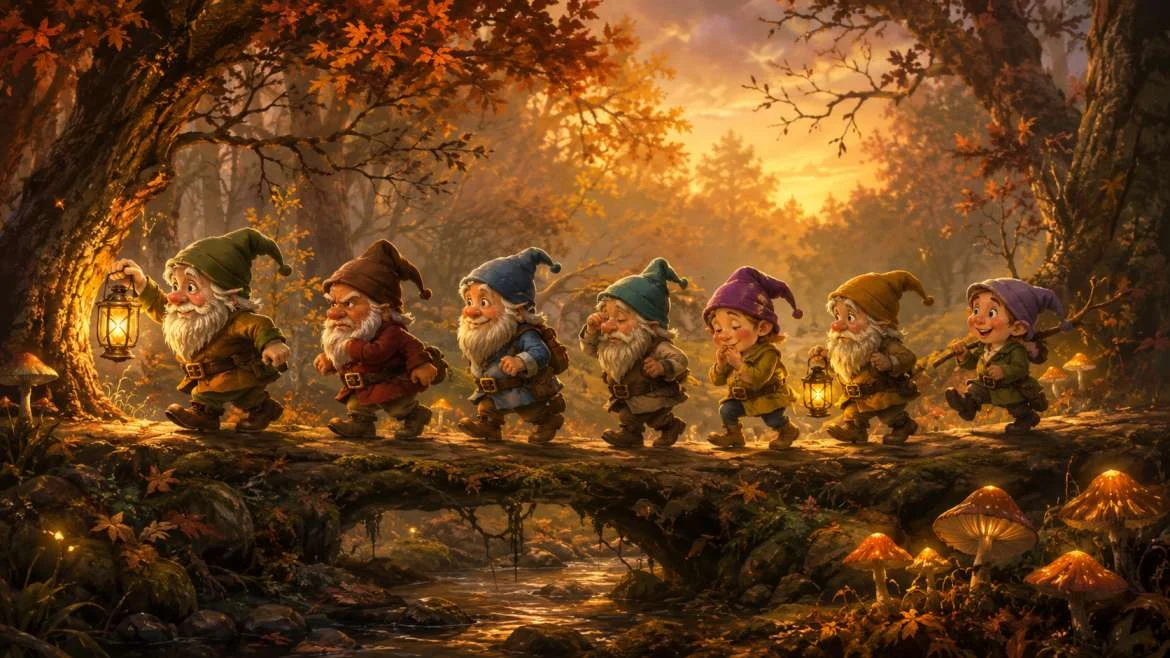
The final seven were chosen because together they created a complete emotional ensemble: leadership (Doc), emotion (Grumpy and Happy at opposite ends), physical state (Sleepy and Sneezy), personality quirks (Bashful and Dopey). Every emotional register of a small community is represented.
It was and remains a masterclass in ensemble character design.
Doc The Leader Who May Not Actually Know Best
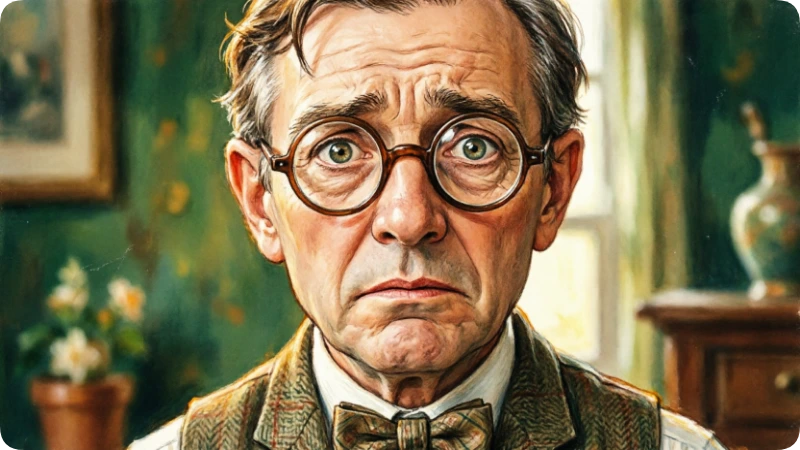
Doc is first among equals in the dwarf household, the one who speaks for the group, assigns the jobs, and maintains the appearance of organized authority. He wears glasses, addresses Snow White first. He is, in the structure of the group, the boss.
But Doc is also and this is the overlooked detail not particularly competent. He muddles his words. His authority is social rather than earned. When he’s flustered, which is often, his carefully constructed leadership persona dissolves immediately into stammering.
Which is, of course, deeply human and deeply lovable.
The name itself is straightforward: it’s a title (doctor, docent, implying knowledge and leadership) repurposed as a proper name. It worked in 1937 and it works now because we all know a Doc, someone who means well, holds things together through sheer confidence, and is both easier to tease and harder to replace than they appear.
What Doc represents: Imperfect leadership. The authority figure who tries harder than he succeeds, and succeeds more than he tries.
In modern terms: The team leader who always starts meetings five minutes late but somehow ends them on time.
Grumpy The Most Complex Dwarf of All
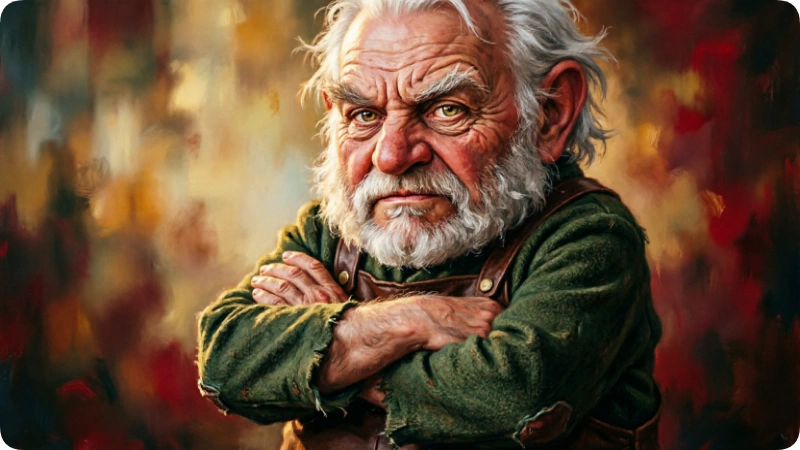
Grumpy is the one everyone remembers most vividly. He’s also the most interesting character in the film, and the most misunderstood.
Yes, he’s grumpy. He’s suspicious of Snow White from the beginning. He votes against letting her stay. He mutters and crosses his arms and looks at the world through narrowed eyes that have been disappointed before and expect to be disappointed again.
But here’s what the film does beautifully with Grumpy: he’s the one who cares most. When the Evil Queen threatens Snow White, it’s Grumpy who rides hardest to reach her. When she’s lying in the glass coffin, it’s Grumpy’s grief that hits hardest. The cynicism is armour. The grumpiness is a man who feels too much and has learned to hide it behind a scowl.
The name Grumpy contains a whole psychology. It comes from the word “grump” possibly derived from the same Germanic root as “grim” and carries associations of low level, chronic dissatisfaction. Not rage, not despair, just the particular unhappiness of someone who has seen enough to expect the worst.
What Grumpy represents: The protective cynic. The person who complains loudest and cares deepest.
In modern terms: The group friend who says they’re not going to enjoy something and has the best time.
Happy The Emotional Anchor Nobody Talks About
Happy is the dwarf most people mention least in discussions, and that’s actually telling. He’s the emotional baseline of the group, the constant, the reliable warmth, the one who laughs first and most genuinely.
His name is entirely literal: happy, from the Old Norse happ meaning “luck” or “chance” the sense that happiness is something that arrives rather than something earned. It’s the simplest name in the seven and perhaps the one that required the most confidence to use, because happiness as a character trait is genuinely difficult to animate interestingly without reducing it to vacancy.
Disney’s Happy avoids that trap by being warm rather than vacant. His joy is directed toward food, toward friendship, toward Snow White, toward the simple pleasures of a working day. He’s not oblivious. He’s chosen.
What Happy represents: The gift of straightforward, undissected contentment. Not naivety chosen warmth.
In modern terms: The friend who somehow always orders the best thing on the menu and shares it without being asked.
Sleepy The Philosopher No One Noticed
Sleepy is chronically, heroically tired and yet he shows up every day.
There’s something quietly profound about Sleepy that gets overlooked because his most prominent characteristic is low energy: he’s always on the verge of sleep, always drooping, always slightly behind the conversation. But he’s there. He mines, sings. He participates in everything despite his entire body lobbying for the opposite.
The name derives directly from the Old English slǣpan to sleep and has a softness to it that matches the character perfectly. It’s the only dwarf name that describes a state rather than a trait: not “Lazy” (which would be unkind) but Sleepy, the person who is always tired but never quite gives in.
What Sleepy represents: Quiet persistence. The exhausted person who shows up anyway.
In modern terms: Every parent of a toddler. Every person who says “I’m so tired” and then does everything on their to do list anyway.
Bashful The Romantic Heart of the Group
Bashful is possibly the most emotionally pure of all the dwarfs. He blushes at Snow White’s arrival, hides behind his beard, looks at his feet when she addresses him directly, and radiates a sweet, uncomplicated romantic admiration that is entirely sincere.
The name comes from the Old French baissier “to lower” related to the sense of lowering one’s eyes in embarrassment. It describes a trait that is genuinely rare in characterisation because writers often confuse bashfulness with weakness when it’s actually a form of sensitivity: the awareness of beauty so acute it makes a person physically uncomfortable.
What Bashful represents: The pure heart. The person whose feelings are too large for their composure to contain.
In modern terms: The person who goes bright red when complimented and insists they’re not blushing while obviously blushing.
Sneezy The One Who Gets the Biggest Laugh
Sneezy has the single best physical gag in the film. His sneezes are catastrophic events capable of knocking over furniture, scattering companions, bending trees. The entire group developed strategies for suppressing them, including the memorable scene where they all collectively hold his nose in anticipation.
The name is direct Old English fnēosan, to sneeze and it works precisely because the condition described is both specific and universal. Everyone has sneezed at a bad moment. Sneezy sneezed at all the moments.
But there’s a warmth to Sneezy that his physical comedy can obscure: he never complains about his condition, never uses it for sympathy. He just handles it, repeatedly, with good natured resignation. That’s genuinely admirable.
What Sneezy represents: The person who deals with their problem with good grace and carries on.
In modern terms: The one who always brings tissues to movie theaters and apologises after every sneeze even though it’s not their fault.
Dopey The One Everyone Loves Most
Ask people which dwarf is their favourite and the answer is disproportionately often Dopey which says something interesting about what we find lovable.
Dopey is the youngest energy of the group (he’s the only one without a beard, suggesting youth in the visual language of the film). He doesn’t speak, has enormous ears. He moves differently from the others, more elastic, more unpredictable, more childlike. And he loves Snow White with a purity and directness that none of the others quite manage.
The name Dopey derives from the slang “dope” originally meaning slow witted or naive which was already in use in early 20th century American English. Walt Disney himself reportedly fought for the name, insisting that it didn’t mean foolish but rather endearingly innocent.
He was right. Dopey isn’t foolish. He’s present in a way the others aren’t quite. He hasn’t built the defences the others have, not Doc’s authority, not Grumpy’s armour, not Bashful’s shyness. He’s just there, wide eyed and open hearted, taking everything in.
What Dopey represents: Pure, undefended openness. The gift of experiencing the world without irony.
In modern terms: The person in the group who laughs the loudest at everything and somehow makes the whole evening better without trying.
The Names That Didn’t Make the Cut
The rejected dwarf names are genuinely fascinating from both a creative and a cultural history perspective. Some were dropped for being too mean spirited (Awful, Dirty, Deafy). While Some were too close to the final names (Cranky, Jumpy). Some were interesting enough that it’s worth wondering what the film would have looked like with them.
| Rejected Name | Why It Was Dropped |
| Jumpy | Too energetically similar to Grumpy |
| Baldy | Unkind rather than affectionately descriptive |
| Nifty | Too vague; doesn’t tell you who the character is |
| Cranky | Redundant alongside Grumpy |
| Deafy | Offensive even by 1930s standards |
| Stuffy | A genuine contender; describes a pomposity that ended up split between Doc and Grumpy |
| Dirty | Appeared in early development materials |
| Wheezy | Passed over; Pixar used it for a penguin in Toy Story 2 |
| Snoopy | Available in 1934; Charles Schulz made it unavailable thereafter |
| Awful | This was apparently genuinely on the table |
Stuffy is the most interesting near miss; it would have added a different dynamic to the group, a particular kind of self important fastidiousness. You can see why it was considered and why it was ultimately cut: that quality was better distributed between Doc and Grumpy than concentrated in one character.
The Dwarfs in Other Versions of Snow White
Disney’s seven names are not the only version. Snow White has been told across multiple media and cultures, and the dwarfs have worn many different names.
The Grimm Brothers Original (1812)
The original Grimm fairy tale has no dwarf names at all. The dwarfs are simply “the seven dwarfs” , a collective presence in the forest, kind but nameless. The story is about Snow White and the Evil Queen; the dwarfs are helpers, not characters.
2012 Film: Snow White and the Huntsman
The dwarfs in this darker, live action version have entirely different names: Beith, Coll, Duir, Gort, Muir, Nion, and Quert all names derived from the Ogham alphabet, the ancient Celtic writing system. This was a deliberate creative choice to root the dwarfs in a specifically Celtic, pre Christian mythological tradition rather than the personality type naming of Disney.
2012 Film: Mirror Mirror
This comedic version used names that were more adjective based in the Disney tradition but different: Grimm, Butcher, Wolf, Napoleon, Half Pint, Grub, and Chuckles darker and more anarchic.
2024 Live Action Disney Remake
The 2024 Disney live action adaptation retained the original seven names but redesigned the characters significantly.
Regional and International Versions
Different European translations of the Disney film sometimes adjusted the names for local linguistic resonance. In German, for example, the dwarfs were named Brummbär (Grumbling Bear), Seppl, Nickel, Pimpel, Hans, Tuck, and Hatschi losing the English trait description system entirely in favour of colloquial names.
Why the Seven Dwarfs Names Are a Masterclass in Character Design
The naming of the Seven Dwarfs was and is recognised as one of the great achievements in character design history. Here’s why they work so completely:
Every name is instantly understood. You don’t need context, backstory, or explanation. “Grumpy” tells you everything immediately. This is an extraordinary design constraint to work within, and the team met it perfectly.
Together, they create a complete emotional spectrum. Happy and Grumpy are emotional poles. Doc is the rational middle. Bashful and Dopey are social extremes (too shy, and beyond shyness entirely). Sleepy and Sneezy are physical conditions. The seven cover the full range of ways a person can be in the world.
The names are affectionate, not cruel. This is subtle but crucial. None of the names are insulting, even the ones describing limitations. “Dopey” could be cruel; Disney insisted it meant innocent. “Grumpy” could be a put down; the film makes it a love language. The names are described without judging.
They create instant ensemble dynamics. You can immediately imagine how these seven personalities would interact: who annoys whom, who protects whom, who makes them laugh. That’s not just good naming; it’s world building.
Frequently Asked Questions
What are the names of the Seven Dwarfs?
The Seven Dwarfs are Doc, Grumpy, Happy, Sleepy, Bashful, Sneezy, and Dopey. Disney created these names specifically for the 1937 animated film Snow White and the Seven Dwarfs. A simple way to remember them is: “Don’t Go Home, Sleep Better Some Days.”
Did the Seven Dwarfs have names in the original fairy tale?
No. In the original Brothers Grimm version of Snow White, the dwarfs are never given individual names. Disney’s writers invented the famous seven names during the movie’s development.
What is the dwarf people usually forget?
Most fans tend to forget Bashful or Sneezy because one is very quiet while the other has a single defining trait. Using a memory phrase can make recalling all seven much easier.
How many names did Disney consider before choosing the final seven?
Disney’s creative team reportedly tested more than 50 possible names, including ideas like Jumpy, Nifty, Cranky, and Wheezy, before settling on the final lineup.
Why doesn’t Dopey have a beard?
Dopey’s missing beard was an intentional design choice that highlights his youthful and innocent personality. He’s also the only dwarf who never speaks in the film.
Are the Seven Dwarfs related?
Disney never confirms that the dwarfs are biological brothers. They are generally portrayed as a close knit found family who live and work together.
Did other versions of Snow White use different dwarf names?
Yes. The original Brothers Grimm story has no dwarf names, while some later adaptations and international versions introduced their own unique naming systems.
Maine aapke article aur queries ko compare kar liya hai. Analysis yeh hai:
What are the names of the Seven Dwarfs in order with pictures?
The Seven Dwarfs are traditionally listed in this order:
| Dwarf | Personality Trait | Visual Feature |
|---|---|---|
| Doc | Leader and organiser | Glasses |
| Grumpy | Cynical but caring | Frown and crossed arms |
| Happy | Cheerful and optimistic | Constant smile |
| Sleepy | Always tired | Drooping eyes and hat |
| Bashful | Shy and romantic | Blushing face |
| Sneezy | Good natured but allergic | Explosive sneezes |
| Dopey | Innocent and playful | No beard and large ears |
While printed books, toys, and websites often include pictures of the Seven Dwarfs, their identifying features make them easy to recognise even without images. Doc wears glasses, Grumpy always frowns, Happy smiles constantly, Sleepy appears exhausted, Bashful blushes, Sneezy struggles with sneezing fits, and Dopey is the only dwarf without a beard.
What are the names of the Seven Dwarfs in Spanish?
The Seven Dwarfs have different names in Spanish translations of Disney’s Snow White and the Seven Dwarfs. The most widely recognised Spanish versions are:
| English Name | Spanish Name |
|---|---|
| Doc | Sabio |
| Grumpy | Gruñón |
| Happy | Feliz |
| Sleepy | Dormilón |
| Bashful | Tímido |
| Sneezy | Mocoso |
| Dopey | Mudito |
Like the English names, the Spanish names are based on each dwarf’s personality or defining characteristic, helping audiences instantly understand each character’s role within the group.
Conclusion
The Seven Dwarfs have been in continuous cultural circulation for nearly 90 years now. That’s not an accident. It’s not just nostalgia, and it’s not just Disney’s marketing reach.
It’s because the names are genuinely excellent. They contain entire people, describe without diminishing. They create a community in seven words and every person who hears them immediately recognizes themselves somewhere in the list.
Most of us are Doc some days and Grumpy on others. We’re Sleepy most mornings and Happy at our best. We’re Bashful in front of the people we want to impress and Dopey in the moments that matter most.
And if you’re very lucky, you know a Sneezy person who deals with their particular difficulty with total good grace, every single day, and never once makes you feel bad for not having the same problem.
That’s what seven perfectly chosen names can do. They become a language.
I am Clara Bennett, a passionate Name Researcher and Content Writer at Nameopediahub.com . I share well-researched content about name meanings, origins, trends, and naming ideas to help readers discover unique and meaningful names from around the world. nameopediahub.com