There’s something quietly powerful about a name rooted in nature. Flower names don’t just sound beautiful, they carry centuries of symbolism, cultural weight, and emotional warmth that few other naming categories can match.
If you’re naming a baby girl, a fictional character, a pet, or looking for username inspiration, flower-inspired names sit at the crossroads of elegance, femininity, mystery, and timeless charm.
And right now? They’re having a serious moment.
From the soft revival of vintage botanicals like Violet and Flora to the Gen Z discovery of underused gems like Calla and Elowen, flower names are flowering (yes, pun intended) across birth registries, TikTok aesthetics, Pinterest boards, and fantasy fiction alike.
This guide doesn’t just list names, it helps you feel them, understand them, and find the one that fits.
Quick Answer: What Are the Most Popular Flower Names?
Featured Snippet: The most popular flower names for girls include Violet, Lily, Rose, Daisy, Jasmine, Iris, Flora, Blossom, Camellia, and Magnolia. For unique flower names, consider Calla, Senna, Azalea, Zinnia, Anemone, Clover, and Acacia. Many flower names work for both such as kids
, including Ash, Reed, Sage, and Basil.
At a Glance: Flower Names by Vibe
| Vibe / Aesthetic | Names |
| Soft & Romantic | Lily, Rose, Violet, Blossom, Camellia |
| Elegant & Timeless | Iris, Flora, Magnolia, Cassia, Hyacinth |
| Rare & Unexpected | Calla, Zinnia, Clover, Senna, Azalea |
| Dark & Mysterious | Anemone, Belladonna, Nightshade, Vesper |
| Cottagecore & Vintage | Daisy, Poppy, Pansy, Primrose, Rue |
| Celestial & Ethereal | Anthea, Leilani, Aurelia, Calantha |
| Bold & Modern | Zara, Nova, Wren, Sage, Briar |
| Fantasy & Fictional | Elowen, Lycoris, Amaranth, Acantha |
Classic Flower Names That Never Age
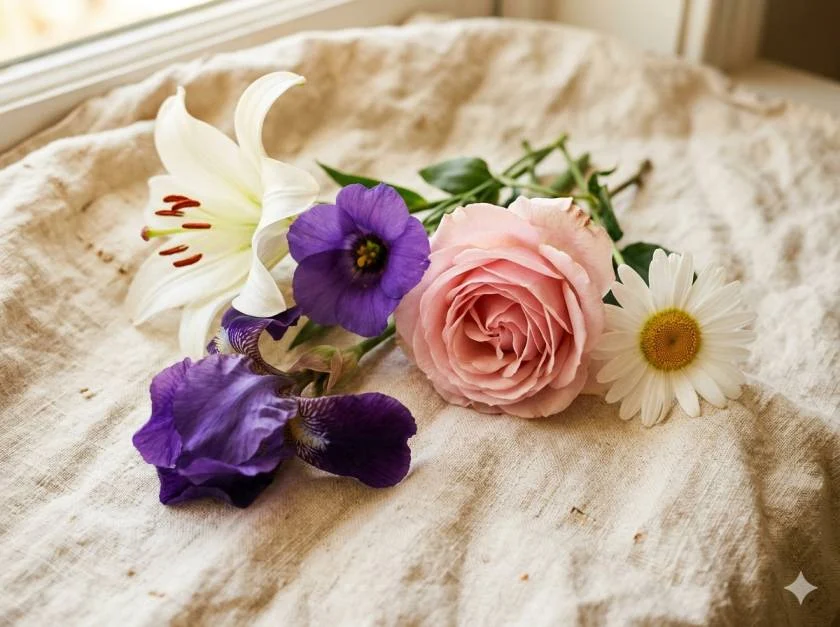
Some names are called “classic” because they’ve genuinely earned it not just because they’re old, but because they keep working across decades, cultures, and naming styles.
Lily
Clean. Feminine. Effortlessly elegant. Lily has been a top-ten girls’ name across the UK and US for over two decades, and somehow it never feels tired. It originates from the Latin lilium and the Greek leirion, symbolising purity, rebirth, and devotion. In Christian iconography, white lilies are associated with the Virgin Mary. In Buddhist art, they represent enlightenment.
The name has an almost architectural simplicity: two syllables, no awkward sounds, strong but soft. It pairs beautifully with longer middle names (Lily Evangeline, Lily Seraphine) and feels just as at home in a Jane Austen novel as on a 2025 birth certificate.
Vibe: Soft, timeless, effortlessly pretty, the literary-girl-next-door.
Rose
Rose is the original flower name. Shakespeare used it. Jane Austen named her heroines around it. It’s a name that carries centuries of romantic association, from medieval courtly love poetry to Titanic‘s Rose DeWitt Bukater. Yet it never collapses under all that history; it wears it lightly.
Short, strong, and vowel-forward, Rose works in nearly every cultural context. It’s also one of the most popular middle names in the English-speaking world, which speaks to its almost universal appeal as a complement to bolder first names.
Vibe: Romantic, literary, quietly powerful, the name that always fits.
Violet
Violet is having a full renaissance. Once considered a slightly dusty Victorian name, it’s now one of the fastest-rising names in multiple English-speaking countries, largely driven by celebrity use (Jennifer Garner and Ben Affleck’s daughter bears the name) and its aesthetic alignment with both vintage and modern sensibilities.
The violet flower symbolises loyalty, remembrance, and modesty. The name has a satisfying weight to its three syllables with a musical quality and the nickname Vi adds an elegant shorthand. It also sits perfectly within the current purple-coded aesthetic that dominates Pinterest and cottagecore TikTok.
Vibe: Vintage-modern, romantically purple, quietly aristocratic.
Iris
Named for the Greek goddess of the rainbow and divine messenger, Iris is one of those names that manages to feel both ancient and completely fresh. It’s been steadily climbing charts since the early 2000s and shows no sign of slowing.
The iris flower itself represents wisdom, hope, and courage in Japanese culture, where different colours carry distinct meanings. In Greek mythology, Iris connected heaven and earth which gives this name a mythological depth that many parents find compelling.
Vibe: Mythological, intelligent, quietly confident.
Daisy
Sun-yellow energy in name form. Daisy is the archetypal cheerful flower name bright, warm, full of bounce. It derives from “day’s eye,” a reference to how the flower opens with sunlight. Historically a nickname for Margaret (via the French Marguerite, which is also a daisy variety), Daisy has long since stepped out from behind its more formal counterpart.
It’s found in literature (The Great Gatsby‘s Daisy Buchanan), music, and now in modern naming culture where its sweet simplicity reads as refreshingly unpretentious. It pairs beautifully with more formal surnames.
Vibe: Sunny, vintage, breezy, sweet the golden retriever of flower names.
Rare and Unique Flower Names Worth Discovering
The best rare names aren’t random; they’re familiar enough to feel accessible while unusual enough to stand out. These are the flower names sitting just below mainstream awareness, waiting to be claimed.
Calla
Calla from the calla lily has a sleek, modern minimalism that feels designed for 2025. It’s Greek in origin (kalos, meaning beautiful), sculptural in silhouette, and rarely used despite sounding effortlessly elegant.
The calla lily is associated with funerary beauty in some cultures, and elegance and resurrection in others, which gives the name a dual complexity.
Nickname options: Cal, Callie.
Vibe: Minimalist, gallery-ready, quietly rare.
Zinnia
Zinnia is underrated in the best possible way. Bright, colourful, botanically authentic, and almost never on the charts this one is for parents who want something genuinely distinctive. The zinnia flower is named after German botanist Johann Gottfried Zinn, and it represents endurance, daily remembrance, and affection.
On aesthetic terms, Zinnia has playful phonetic energy; the Z opening gives it a punchy modernity while the floral association keeps it grounded and warm. Nickname: Zinny, Zia.
Vibe: Bold, colourful, confidently unusual.
Clover
Technically a wildflower rather than a garden bloom, Clover belongs in this category because it captures exactly the naturalness and simplicity that make plant names resonate right now. Associated with luck, fairy lore, and Irish heritage, it’s one of the gentler unisex flower names gaining traction in nature-naming circles.
It also has a strong cottagecore and soft-indie aesthetic, the kind of name you’d find in a folk album liner or a Hayao Miyazaki film.
Vibe: Earthy, lucky, soft-indie cottagecore.
Senna
Senna is a flowering shrub used in traditional herbal medicine across Asia, the Middle East, and Africa. As a name, it has a lyrical, cross-cultural quality; it sounds like it could be Italian, Arabic, or Scandinavian. It’s virtually unused in Western naming contexts, which makes it a genuine discovery for parents who love unusual botanicals.
Vibe: alluring, herbal, worldly, softly mysterious.
Acacia
The acacia tree blooms in brilliant yellow and has deep symbolic meaning across multiple cultures: immortality in Egypt, secret love in Victorian flower language, resilience in Australian Aboriginal traditions. As a name, Acacia has four melodic syllables and a slightly wild, adventurous spirit.
Nickname: Cay, Cacia, Aca.
Vibe: Adventure-coded, botanically authentic, globally resonant.
Anemone
For the truly brave name-givers. Anemone (pronounced ah-NEM-oh-nee) is one of those names that looks intimidating on paper but sounds genuinely beautiful spoken aloud. In Greek mythology, anemones grew from the tears of Aphrodite mourning Adonis which gives this name a romantic, almost tragic poetic depth.
It’s a name for literary parents, mythology lovers, and anyone who wants a name that will absolutely never appear on another child’s name tag.
Vibe: Deeply literary, mythological, boldly unusual.
Vintage Flower Names Making a Comeback
Naming culture moves in cycles, and the current wave is firmly in favour of names that feel like they’ve been found in a grandmother’s diary dusty, beautiful, and quietly longing to be used again.
Primrose
Primrose feels lifted from an Edwardian garden party. It’s the English name for the Primula flower, which blooms early in spring (hence the Latin root primus, “first”). In British culture, Primrose Day (April 19th) commemorates Benjamin Disraeli lending this name a layer of historic weight.
With The Hunger Games‘ Primrose Everdeen giving the name modern exposure, it’s finding a new generation of admirers who love its whimsical, literary quality.
Nickname: Prim, Rosie.
Vibe: Edwardian, whimsical, literary, deeply English.
Pansy
Pansy was once as common as Lily or Daisy. It disappeared largely due to unfortunate slang associations in the mid-20th century, but there’s a genuine revival conversation happening around it in naming communities. The pansy represents remembrance and free thinking Shakespeare referenced in A Midsummer Night’s Dream (“that’s for thoughts”). It also appears in the Harry Potter universe as Pansy Parkinson, which gives it some fictional reattachment.
Vibe: Retro-brave, theatrical, Shakespearean.
Rue
Small, ancient, and steeped in symbolism, Rue is the name of the herb used in traditional European folk medicine and associated with regret and grace in Victorian flower language. It’s also a Hunger Games character name, which introduced it to a new generation.
As a name, it’s monosyllabic, gentle, and carries an almost elegiac quality of soft grief, quiet beauty. It suits the modern minimalist aesthetic perfectly.
Vibe: Mournful-beautiful, minimalist, vintage-literary.
Eglantine
You won’t find this one on any popularity chart, and that’s precisely the point. Eglantine is the old English name for the sweetbriar rose, thorny, wild, and intensely fragrant. It was used in medieval poetry and appears in Chaucer’s Canterbury Tales. It has a slightly theatrical, romantic-era quality that makes it both unusual and completely intentional-feeling.
Nickname: Eggy (admittedly a bold choice), Tine, Lanie.
Vibe: Medieval, wild-romantic, deeply literary.
Flower Names for Boys Yes, Really
Floral masculinity isn’t as unusual as you might think. Many cultures have long traditions of plant-based male names, and contemporary gender-neutral naming trends are opening space for more.
| Name | Origin | Meaning / Plant |
| Ash | Old English | The ash tree, strength |
| Reed | Old English | Marsh grass, musical |
| Basil | Greek | King (also the herb) |
| Sage | Latin | The sage plant, wisdom |
| Briar | Old English | Thorny shrub, wild |
| Rowan | Gaelic | The rowan tree, protection |
| Florian | Latin | Flowering, related to flora |
| Sorrel | Old French | A tart herb, copper-haired |
| Cedar | Hebrew origin | The cedar tree, strength |
| Birch | Old English | The birch tree, renewal |
Florian deserves special mention; it’s the male equivalent of Flora and carries the same floral Latin root. It’s popular in Central Europe and has a warmth and muscularity that avoids feeling overly feminine for parents who want a clearly botanically-inspired masculine name.
Rowan sits in the sweet spot of truly unisex used equally for such as kids in the UK and increasingly in the US and Australia, with strong Celtic heritage and woodland symbolism.
Flower Names from Around the World
Some of the most beautiful floral names aren’t English at all. Exploring global botanical traditions opens up a much richer palette.
Japanese Flower Names
| Name | Meaning |
| Hana (花) | Flower |
| Sakura (桜) | Cherry blossom |
| Ayame (菖蒲) | Iris |
| Yuri (百合) | Lily |
| Sumire (菫) | Violet |
| Botan (牡丹) | Peony |
Sakura is the most internationally recognised Japanese flower name, carrying the philosophy of mono not aware of the bittersweet beauty of impermanence. It’s both deeply Japanese and accessible to Western ears.
Indian & South Asian Flower Names
| Name | Meaning |
| Kamala | Lotus (Sanskrit) |
| Pushpa | Flower (Sanskrit) |
| Jasmine | From Persian yasmin |
| Chameli | Jasmine flower |
| Nirmala | Pure as a flower |
| Padma | Lotus (Sanskrit) |
Kamala and Padma both reference the lotus, the sacred flower of creation in Hindu and Buddhist traditions, representing purity rising from muddy water. These names carry profound spiritual resonance.
Celtic & Norse Botanical Names
| Name | Meaning |
| Elowen | Elm tree (Cornish) |
| Rhoswen | White rose (Welsh) |
| Blodeuwedd | Flower-face (Welsh mythology) |
| Linnea | Linden tree (Scandinavian) |
| Sigrid | Victory, associated with fir |
Elowen is particularly notable right now as a rare Cornish name meaning “elm tree” that feels like a fantasy name but carries genuine Celtic heritage. It’s all over UK naming forums and gaining traction in Australia and New Zealand.
Dark & Gothic Flower Names
Not every bloom is soft and sunny. Some flowers carry darker, stranger, more complex symbolism and the names that come with them reflect that beautifully.
Lycoris
The lycoris, also called the spider lily or red spider amaryllis, is the higanbana of Japanese Buddhist tradition, the flower of the underworld, blooming on graves, guiding the dead. It’s one of the most strikingly beautiful flowers in existence, and its dark symbolism has made it a staple of anime aesthetics (see: Demon Slayer, Given).
As a name, Lycoris is rare, ancient (it was a Roman actress’s name), and deeply atmospheric.
Vibe: Dark, anime-coded, hauntingly beautiful.
Belladonna
Technically a nightshade plant rather than a flower, but Belladonna has such rich naming potential it would be wrong to omit. It means “beautiful woman” in Italian the plant was used historically in beauty rituals and as poison. As a name, it’s theatrical, literary, and unmistakably gothic.
Vibe: Dramatically gothic, Italian, wildly unusual.
Amaranth
The amaranth flower is associated with immortality across multiple cultures; its name means “unfading” in Greek. In Renaissance art it symbolised loyalty beyond death. As a name, it’s weighty, unusual, and carries a kind of quiet grandeur.
Vibe: Immortal, literary, romantically dark.
Flower Names and Their Hidden Symbolism
Victorian floriography, the language of flowers, assigned precise meanings to each bloom. Understanding this tradition adds another layer to choosing a flower name.
| Flower | Traditional Symbolism |
| Lily of the Valley | Return of happiness |
| Forget-Me-Not | True love, remembrance |
| Camellia | Longing, admiration |
| Peony | Romance, good fortune |
| Lavender | Devotion, calm |
| Marigold | Grief, but also creativity |
| Lotus | Purity, enlightenment |
| Poppy | Sleep, remembrance (WW1) |
| Chrysanthemum | Fidelity (Asia), death (Europe) |
| Wisteria | Devotion, obsessive love |
This matters for naming because it can add an intentional layer of meaning. A child named Camellia carries “admiration” within her name. A child named Amaranth carries “unfading.” These aren’t trivial associations; they’re layers of storytelling embedded in the choice.
Flower Names for Pets, Characters & Usernames
Flower names aren’t only for babies. They’ve become popular across creative contexts.
For pets: Daisy, Poppy, Blossom, Clover, Briar, Lily, Petal all work beautifully for cats, dogs, and rabbits. Smaller animals tend to suit shorter names; cats especially suit the slightly mysterious (Iris, Rue, Senna).
For fictional characters: Anemone, Lycoris, Amaranth, Belladonna, Elowen, Calantha, Rhoswen these carry world-building weight, suggesting characters with depth, history, and a connection to nature or magic.
For usernames: Botanical names work exceptionally well as aesthetic usernames because they’re unusual, beautiful, and rarely taken. Try @zinnia.rose, @clalandacalla, @sen.na, @briarlane, or @lycoris.bloom.
How to Choose the Right Flower Name
There’s no algorithm for this. But here are the questions worth asking yourself:
How does it feel to say it out loud? Say the name 20 times. Shout it across a garden. Whisper it. Names live in the mouth as much as on paper.
Does it carry the meaning you want to pass on? Symbolism matters if it matters to you. Don’t feel obligated to choose based on meaning but if it resonates, let it.
How does it sit with your surname? Avoid too many syllables stacking against a long surname. Amaranth Henderson is harder to carry than Rue Henderson.
Does it allow for nickname flexibility? Some parents want nickname options. Camellia gives you Cami, Millie, Ella. Rue gives you nothing which some people prefer for its singularity.
Is it too trendy, or genuinely timeless? Trends aren’t inherently bad, but consider whether this name will feel dated in 30 years. Lily and Rose probably won’t. Some very on-trend names might.
Frequently Asked Questions
What are the most popular flower names for girls? Lily, Rose, Violet, Jasmine, Iris, Daisy, and Flora consistently rank among the most popular flower names for girls in the UK, US, and Australia. Violet has seen the biggest recent surge in popularity.
Are flower names good for boys? Yes, names like Rowan, Ash, Reed, Basil, Sage, Florian, and Briar all have strong botanical connections and work well for boys. Many are genuinely unisex. There’s growing cultural acceptance for floral-inspired male names.
What is the rarest flower name? Some of the rarest genuine flower names include Eglantine, Amaranth, Anemone, Senna, Blodeuwedd, Calantha, and Lycoris. These are almost never in use as given names, making them genuinely distinctive choices.
What flower names have the best nicknames? Camellia (Cami, Millie), Primrose (Prim, Rosie), Acacia (Cay, Cacia), Violet (Vi), Zinnia (Zinny, Zia), and Hyacinth (Cindy, Hy) all offer good nickname flexibility.
Are flower names falling out of fashion? Not quite the opposite. Nature names including floral names are among the fastest-growing naming categories globally, driven by cottagecore aesthetics, climate awareness, and a broader cultural shift toward natural, meaningful names.
Can I use a flower name for a surname? Absolutely. Floral surnames have a long tradition: Rose, Field, Heath, Wood. A first-name flower used as a surname would be a distinctive and beautiful choice for fictional characters or pen names.
The Final Word
Flower names occupy a rare space in the naming world: they’re ancient and modern at once, globally understood yet personally specific, symbolically rich without being heavy-handed.
If you choose something as familiar as Lily or as unexpected as Anemone, you’re drawing from thousands of years of human relationship with the natural world which is, when you think about it, not a bad place to root a name.
The best flower name isn’t the most popular one, or the rarest one, or even the most beautiful one. It’s the one that, when you say it, makes something click.
Trust that feeling.

I am Olivia Hayes, a dedicated Name Researcher and Content Writer at NameopediaHub.com. I create engaging and well-researched content about name meanings, origins, trends, and unique naming ideas to help readers explore the fascinating world of names. nameopediahub.com