
Science has named a bat after Yoda, a spider after David Bowie, and even a species in honor of Beyoncé, showing that taxonomy is as creative as it is scientific.
Scientific animal names, built from Latin and Greek, are far more than formal labels. They preserve stories of mythology, geography, appearance, history, and the people who discovered or inspired each species.
Names like Panthera leo, Vulpes vulpes, and Homo sapiens carry meanings that reveal fascinating insights, while unusual examples such as Baracktrema obamai prove scientists often have a playful sense of humor.
If you’re a biology student, writer, pet owner, or simply curious about wildlife, understanding scientific names adds a new layer of appreciation for the natural world.
Behind every binomial name is a story, making scientific animal names one of the most remarkable intersections of language, science, and human creativity.
Featured Snippet:
Scientific animal names follow a system called binomial nomenclature, developed by Swedish naturalist Carl Linnaeus in the 18th century. Every species has a twopart Latin or Latinized name: the genus name (capitalized, e.g. Panthera) and the species epithet (lowercase, e.g. leo). Written together in italics, they form a unique species identifier used universally across languages. Names are drawn from Latin, Ancient Greek, descriptive terms, geographic locations, mythology, and honorifics for scientists, explorers, and occasionally celebrities.
How Scientific Animal Names Are Structured and Standardized
| Name Component | Example | What It Means |
| Genus | Panthera | “Panther” from Greek panthēr |
| Species | leo | “Lion” Latin |
| Full name | Panthera leo | The lion |
| Authority | (Linnaeus, 1758) | Who named it, and when |
| Common name | African Lion | What most people call it |
The International Code of Zoological Nomenclature (ICZN) governs animal naming. Unlike common names which vary by country, language, and region a scientific name is the same in every language on Earth. A biologist in Japan and a biologist in Brazil are talking about exactly the same creature when they say Panthera leo.
The Most Beautiful Scientific Animal Names Ever Given
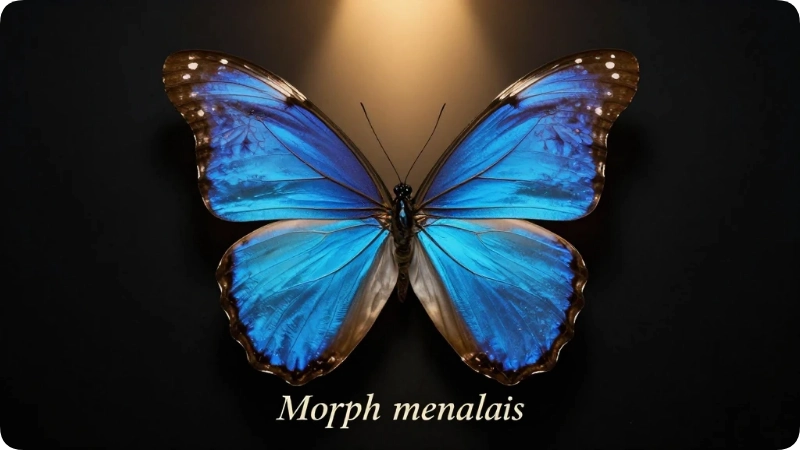
Beauty in scientific naming usually comes from one of three sources: the rhythm of Latin and Greek syllables, the vividness of the description being encoded, or the mythological resonance of the reference. These names earn all three.
Draco volans The Flying Dragon Lizard
Draco is Latin for dragon. Volans is Latin for flying. So the official scientific name of the Southeast Asian gliding lizard is, quite simply, flying dragon which is both scientifically accurate (it glides using extended rib structures) and the most magnificent name any animal has ever been given. It sounds like something from a Tolkien appendix and refers to an actual creature you can find in Philippine forests.
Vibe: Fantasy made real. The name you’d give a familiar in a witch’s grimoire. Why it’s remarkable: Taxonomists usually resist poetic names. Here they couldn’t help themselves.
Panthera onca The Jaguar
Panthera comes from Greek “all beast,” or possibly related to Sanskrit pundarīka (tiger). Onca derives from the Portuguese onça, itself from the Latin lyncea, meaning “lynxlike.” The jaguar’s scientific name encodes a transcontinental linguistic journey: Greek mythology, Sanskrit roots, Portuguese colonial naming, and Latin formalization, all compressed into two words for an animal that has lived in the Americas for over two million years.
Vibe: Ancient. Mythological. The name carries the weight of three continents.
Cygnus cygnus The Whooper Swan
When a taxonomist decides an animal is so fundamentally, perfectly, archetypally itself that the only honest name is the same word twice, the result is a tautonym and Cygnus cygnus is one of the most beautiful ones. Latin cygnus, from Greek kyknos, meaning swan. The whooper swan is so completely a swan that it is named swanswan. There is something philosophically satisfying about this.
Vibe: Pure. Elemental. The naming equivalent of saying “the most itself version of itself.”
Morpho menelaus The Menelaus Blue Morpho Butterfly
The iridescent blue morpho butterflies of South America are named after Morpheus, the Greek god of dreams because their extraordinary metallic blue wings were thought to resemble a dream made visible. Menelaus adds the Homeric king of Sparta, husband of Helen, which gives this butterfly’s name an entire Greek epic compressed within it. The butterfly itself is one of the most visually stunning creatures on Earth. The name does it justice.
Vibe: Dreamworld. Mythological. The butterfly equivalent of a prose poem.
Canis lupus familiaris The Domestic Dog
The domestic dog’s full trinomial scientific name is an entire relationship history: Canis (dog), lupus (wolf), familiaris (of the family, domestic). The dog is officially, scientifically, a familiar wolf, a wolf who joined the family. That is one of the most quietly beautiful descriptions in all of biology, and it’s been sitting in the taxonomy since Linnaeus published it.
Vibe: Warmth. Ancient partnership. The name carries 15,000 years of coevolution.
Felis catus The Domestic Cat
Felis from Latin, meaning cat. Catus from Latin cattus, also meaning cat but with a connotation of “shrewd” or “knowing.” The domestic cat is therefore officially a shrewd cat or a knowing cat, which anyone who has spent time with one will recognize as the most accurate scientific description in existence.
Vibe: Precise. Slightly smug. Perfectly feline.
Scientific Names That Tell Extraordinary Stories
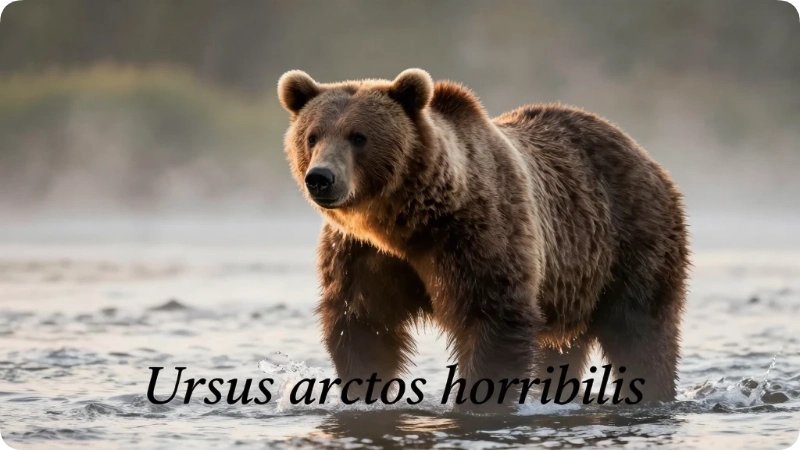
Some of the most remarkable scientific names aren’t the most beautiful they’re the ones that reveal the most about the history of how the species was encountered, described, and understood.
Ursus arctos horribilis The Grizzly Bear
Ursus is Latin for bear. Arctos is Greek for bear (from the same root that gives us “Arctic” the northern bear region). Horribilis is Latin for “horrible, causing horror.” The grizzly bear is therefore officially the horrible northern bear, a name given by the naturalist George Ord in 1815 after reading descriptions of Lewis and Clark’s encounters with them in the American West. Those encounters were not pleasant. The name is honest.
Overlooked insight: The word “Arctic” and the scientific name for “bear” share the same ancient root. The far north is literally the land of the bear, named for the constellation Ursa Major (the Great Bear) visible there.
Vulpes vulpes The Red Fox
Another perfect tautonym. Vulpes means fox in Latin. Linnaeus looked at the red fox, the most foxlike of all foxes, the one from which our entire cultural concept of “fox” is drawn, the creature in Aesop’s fables and fairy tales and named it fox fox. This was either a statement of elegant simplicity or a moment of inspired laziness, and it’s impossible to tell which.
What it tells us: The red fox is so completely the archetype of foxness that doubling the name was the only honest option.
Homo sapiens The Human
Homo is Latin for “human being” or “man.” Sapiens is Latin for “wise” or “knowing.” Carl Linnaeus, naming the human species in 1758, called us Homo sapiens the knowing human, the wise one. This is the name we gave ourselves. No outside observer classified us. We are the only species that named its own species, and we chose to call ourselves wise. If this is aspiration, hubris, or accurate description remains actively debated.
Vibe: Everything. The weight of self-awareness and all its complications.
Tyrannosaurus rex The Tyrant Lizard King
The most famous scientific animal name on Earth is also one of the most magnificent. Tyrannosaurus from Greek tyrannos (tyrant) + sauros (lizard). Rex from Latin, king. The Tyrant Lizard King. Named by Henry Fairfield Osborn in 1905 and he was absolutely committed to the drama. No taxonomist has ever named anything with more confidence.
Cultural footprint: T. rex appears in more films, children’s books, and cultural references than any other extinct animal. The scientific name has crossed fully into mainstream use “T. rex” is understood globally.
Hippopotamus amphibius The Hippopotamus
Hippos is Greek for horse. Potamos is Greek for river. Amphibius from Greek amphibios, meaning “living a double life” (on land and in water). The hippopotamus is therefore officially the river horse that lives a double life which is both zoologically accurate and sounds like the description of a character in a myth. The name was given by ancient Greeks who encountered hippos along the Nile and made a reasonable if imprecise comparison.
Scientific Names Inspired by Mythology & Ancient Worlds
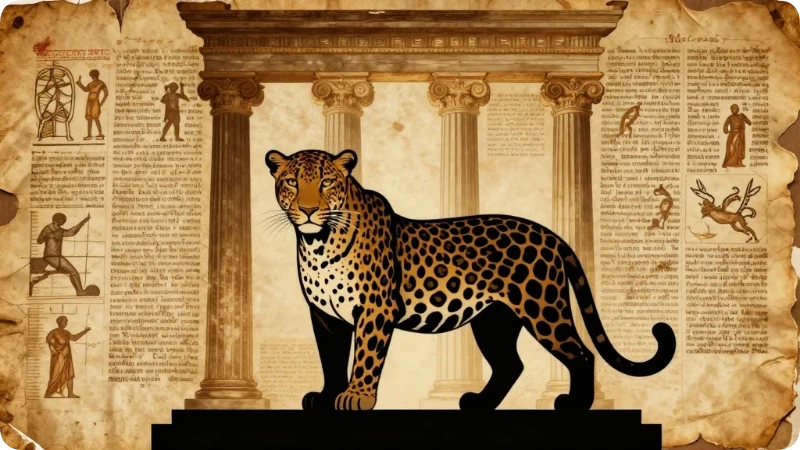
The taxonomists of the 18th and 19th centuries were classically educated scholars who reached naturally for Greek and Roman mythology when names were needed. The result is a biological catalog full of gods, monsters, and heroes.
| Scientific Name | Common Animal | Mythological Reference |
| Hydra vulgaris | Freshwater polyp | Lernaean Hydra, the multiheaded serpent |
| Pegasus (genus of flying fish) | Flying fish | Pegasus, the winged horse of Greek myth |
| Medusa (jellyfish stage) | Jellyfish | Medusa, the Gorgon the resemblance is exact |
| Minotaurus (beetle genus) | Dung beetle | The Minotaur of Crete |
| Hercules (moth genus) | White Witch Moth | Hercules, for its enormous wingspan |
| Achilles (tang fish) | Achilles Tang | Named for the bright mark near its tail |
| Noctua (moth genus) | Various owlet moths | Latin for owl; nocturnal association |
| Lycaon pictus | African Wild Dog | Lycaon, the Greek king transformed into a wolf |
| Sphinx (hawkmoth genus) | Hawkmoths | The Great Sphinx; their hovering posture |
| Argus (genus in Nymphalidae) | Various butterflies | Argus, the hundredeyed giant of Greek myth |
Lycaon pictus The African Wild Dog
This name deserves a longer look. Lycaon was a king of Arcadia in Greek mythology who served human flesh to Zeus and was transformed into a wolf as punishment in one of the origin stories of lycanthropy, of werewolves. Pictus means “painted” in Latin, describing the animal’s extraordinary mottled coat. The African wild dog is therefore officially the painted werewolf, and it is one of the most efficient predators on Earth, with a hunting success rate of around 85%. The name is just.
Scientific Names Given to Honor People Eponymous Species
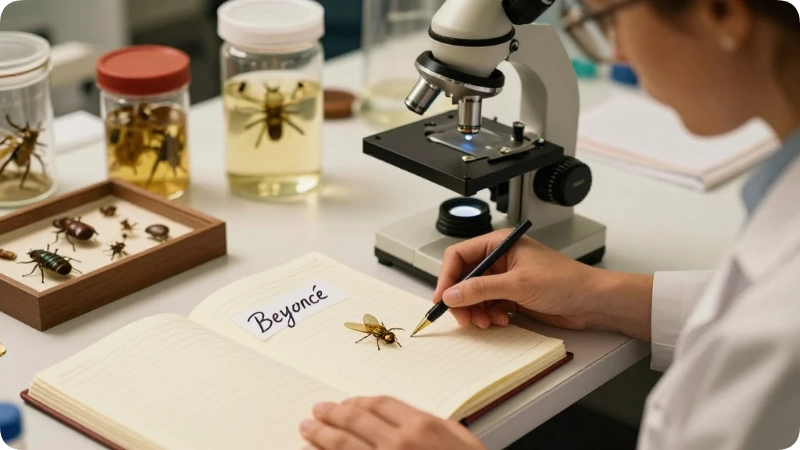
One of taxonomy’s great traditions is naming newly discovered species after people who have inspired, funded, or otherwise advanced science or occasionally just because the naming scientist admired someone.
Scientists & Explorers
| Scientific Name | Species | Named For |
| Darwinia (plant genus) | Various flowering plants | Charles Darwin |
| Linnaea borealis | Twinflower plant | Carl Linnaeus himself |
| Attenboroughia (genus) | Carnivorous pitcher plant | David Attenborough |
| Agra schwar zeneggeri | Rove beetle | Arnold Schwarzenegger |
| Neopalpa donaldtrumpi | Moth species | Donald Trump (for golden head scales) |
Celebrities & Cultural Figures
This is where scientific naming gets genuinely delightful. Taxonomists are, it turns out, human beings with pop culture awareness and a persistent sense of humor.
David Bowie Heteropoda davidbowie, a large spider from Malaysia, named for Bowie’s iconic orange hair matching the spider’s coloration. Also Ampulex dementor, the cockroachzombifying wasp, named after the Dementors of Harry Potter because of its behavior.
Beyoncé Scaptia (Plinthina) beyonceae, a species of horse fly from Queensland, Australia, named in 2011. The entomologist who named it noted that the fly, discovered in 1981 (the year Beyoncé was born), had an extraordinarily golden abdomen. The name has been cited in every major news outlet worldwide, perhaps the most successful taxonomy press release in history.
Barack Obama Barracktrema obamai, a blood fluke that parasitizes freshwater turtles. The scientist who named it clarified it was “a mark of respect” the parasite is, after all, specialized and critically important to its ecosystem. The President was reportedly amused.
Sir David Attenborough Several species across multiple kingdoms have been named for him, including Materpiscis attenboroughi, an ancient fish that gave live birth, and Cascolus ravitis, a crustacean from the Cretaceous. No living person has had more species named in their honor.
The Most Surprisingly Funny Scientific Animal Names
Taxonomists operate under professional naming codes, but human creativity finds its way through regardless. Some names are funny because of what the Latin means; others because of who or what they reference.
Agra cadabra A beetle genus with a species epithet that creates the world’s most beloved magic word. Real. Fully legitimate. Agra cadabra is a rove beetle found in Central America.
Ba humbugi A land snail from Mba Island, Fiji. Ba for the island, humbug for the snail’s striped pattern resembling a humbug candy. Named in 1992 by biologist Brian Iredale. It is real and it is perfect.
Pieza pi A hover fly genus with a species named pi. There are also species in the genus named Pieza rhea, Pieza kake (piezcake), and Pieza deresistans (piece de résistance). The entomologist responsible was clearly enjoying themselves enormously.
Aha ha A species of Australian wasp. The naming entomologist, Arnold Menke, reportedly wrote in a letter to a colleague “I’ve been saving ‘Ha’ for a special occasion” and then chose the two-syllable version when he found an especially exciting new specimen.
Ytu brutus Another beetle. The genus Ytu combined with brutus gives us “you too, Brutus” the most famous assassination quotation in history, delivered by a diving water beetle.
Scientific Names as Pet Names A Growing Trend
An unexpected and genuinely lovely naming trend is emerging among animal lovers: using the scientific genus or species name, or a shortened version of it, as a pet name.
Genus names as pet names:
- Felis → Felis (cat name, elegant and rarely used)
- Canis → Canis (dog name unusual, clean, strong)
- Vulpes → Vulpes or “Volpe” (Italian diminutive, beautiful for a foxcolored dog or cat)
- Aquila → Aquila (Latin for eagle striking for a large, noble dog)
- Corvus → Corvus (the genus of crows and ravens magnificent for a black cat or dog)
- Lupus → Luna is already everywhere; Lupus is the rarer, more striking wolf name
Species epithets as names:
- Regalis (regal) magnificent for a dignified pet
- Stellaris (of the stars) beautiful for a pet with starry markings
- Elegans (elegant) self-explanatory and accurate for certain pets
- Nocturnus / Nocturna for a nightactive or darkcolored animal
- Chrysaetos (golden eagle) for a goldencoated pet
The growing “taxonomy pet name” community on Reddit, TikTok, and niche pet owner forums is increasingly naming animals with scientific names or genusderived names as a way of honoring the animal’s species, signaling biological literacy, and simply finding names that are beautiful in an unusual register.
Scientific Animal Name Categories by Aesthetic
🌿 Mythologically Resonant
Draco volans, Lycaon pictus, Medusa, Morpho menelaus, Sphinx, Pegasus, Hercules
🌑 Dark & Gothic
Ursus arctos horribilis, Hecate (moth genus), Noctua, Morrigan (spider genus), Erebus (moth genus named for the Greek god of darkness)
✨ Celestial & Ethereal
Stellaris, Cygnus cygnus, Astraea (sea star genus), Lunaris, Nocturna, Lyra
🎭 Dramatic & Powerful
Tyrannosaurus rex, Panthera onca, Aquila chrysaetos (golden eagle), Regulus (kinglet bird genus “little king”)
🌸 Soft & Beautiful
Morpho, Calidris (sandpiper genus), Columbina (dove genus), Meleagris (turkey genus, but the word is beautiful regardless)
😄 Playful & Surprising
Agra cadabra, Ba humbugi, Aha ha, Ytu brutus, Pieza pi
Frequently Asked Questions
What is the scientific name for animals in general?
Animals as a kingdom are classified under Animalia, the Latin name for the entire animal kingdom, covering every multicellular organism that is not a plant, fungus, or microorganism. Within Animalia, all vertebrate animals belong to the phylum Chordata.
Why are scientific animal names in Latin?
Latin (and Ancient Greek) were chosen by Carl Linnaeus in the 18th century because they were the universal languages of European scholarship understood by scientists of every nationality. Latin also has the advantage of being a “dead” language, meaning it doesn’t change, which keeps scientific names stable across centuries. A name given in 1758 means exactly the same thing today.
What is the most famous scientific animal name?
Tyrannosaurus rex is almost certainly the most globally recognized scientific animal name, followed by Homo sapiens. Both have entered mainstream language well beyond scientific contexts.
Can you use scientific animal names as pet names?
Absolutely and it’s a growing trend. Genus names like Corvus (crow), Aquila (eagle), Vulpes (fox), and Lupus (wolf) make beautiful, unusual pet names. Species epithets like Regalis, Stellaris, and Elegans work as elegant, meaningful names for any pet.
What is the funniest scientific animal name?
Agra cadabra (a rove beetle), Ba humbugi (a Fijian snail), and Aha ha (an Australian wasp) are consistently cited as the most deliberately humorous legitimate scientific names. Pieza pi and Ytu brutus are close runnersup.
What animal has the most interesting scientific name and why?
Many biologists and naturalists cite Lycaon pictus (the African wild dog literally “painted werewolf”) and Canis lupus familiaris (the domestic dog literally “familiar wolf”) as the most narratively interesting. Homo sapiens is arguably the most philosophically significant, since it’s the only species name a species gave to itself.
What Scientific Names Really Are
At their best, scientific animal names are compressed literature. They contain Greek epics, Roman mythology, the names of explorers and their ships, the observations of naturalists who spent decades in jungles or deserts or coral reefs, the humor of scientists working alone in labs at 2am, and the accumulated wonder of human beings trying to organize and understand the extraordinary variety of life on Earth.
Draco volans is a flying dragon in a Philippine forest. Morpho menelaus is a Greek hero’s name on a dreaming butterfly’s wings. Canis lupus familiaris is fifteen thousand years of wolves choosing to stay near human fires, compressed into three words.
These names are not just classification. They are a record of every time a human being looked at another creature, a spider, a beetle, a whale, a moth, a bacterium and reached for language beautiful enough to do it justice.
Sometimes they found it. Sometimes they named a snail Ba humbugi and called it a day.
Both responses are deeply human. And somehow, equally right.

I am Olivia Hayes, a dedicated Name Researcher and Content Writer at NameopediaHub.com. I create engaging and well-researched content about name meanings, origins, trends, and unique naming ideas to help readers explore the fascinating world of names. nameopediahub.com