Featured Snippet
Indoor plants have hundreds of common and botanical names from the beloved Pothos (Epipremnum aureum) and Peace Lily (Spathiphyllum wallisii) to trendy varieties like Monstera, String of Pearls, and Pilea. Whether you’re naming your houseplant collection or searching for the perfect plant by name, this guide covers common names, botanical names, aesthetic name categories, and unique naming ideas for plant parents.
Why Plant Names Matter More Than You Think

There’s something quietly powerful about knowing a plant’s name.
Walk into any plant shop, and you’ll notice it immediately the difference between the person who points at a shelf and says “that one with the holes in the leaves” versus the person who asks for a Monstera deliciosa. One feels uncertain. The other feels like they belong.
But plant names aren’t just for botanists or Instagram aesthetics. They’re your plant’s identity a window into its personality, its origins, its mythology. The Peace Lily didn’t earn that name by accident. The Devil’s Ivy certainly didn’t either.
Whether you’re a new plant parent trying to identify what you just brought home, a collector hunting rare varieties by their Latin names, or someone who genuinely wants to name their houseplant like a beloved pet this guide is for you.
We’ve organized over 150 indoor plant names by vibe, category, and naming use-case so you can explore, feel, and choose with confidence.
A Quick Overview: Indoor Plants by Naming Category
| Category | Examples | Best For |
| Classic & Beloved | Pothos, Peace Lily, Snake Plant | Beginners, everyday plant parents |
| Botanical Latin Names | Monstera deliciosa, Ficus lyrata | Collectors, serious growers |
| Dramatic & Dark | Black Velvet Alocasia, Raven ZZ | Gothic & moody aesthetics |
| Soft & Romantic | String of Hearts, Baby Tears | Cottagecore, boho spaces |
| Royal & Sculptural | Bird of Paradise, Fiddle Leaf Fig | Statement interiors |
| Celestial & Mystical | Moonshine Snake Plant, Stardust Cactus | Fantasy & spiritual vibes |
| Quirky & Playful | Bunny Ear Cactus, Panda Plant | Fun, unique personalities |
| Vintage & Nostalgic | African Violet, Cast Iron Plant | Classic homes, grandmillenial style |
| Tropical & Lush | Monstera, Bird’s Nest Fern | Jungle aesthetic lovers |
| Minimalist Modern | Pilea, Air Plant, ZZ Plant | Clean, Scandinavian interiors |
Indoor Plant Names (And What They Really Feel Like)
These are the names you’ll see everywhere on Pinterest boards, in plant shops, and in living rooms that smell faintly of potting soil and possibility.
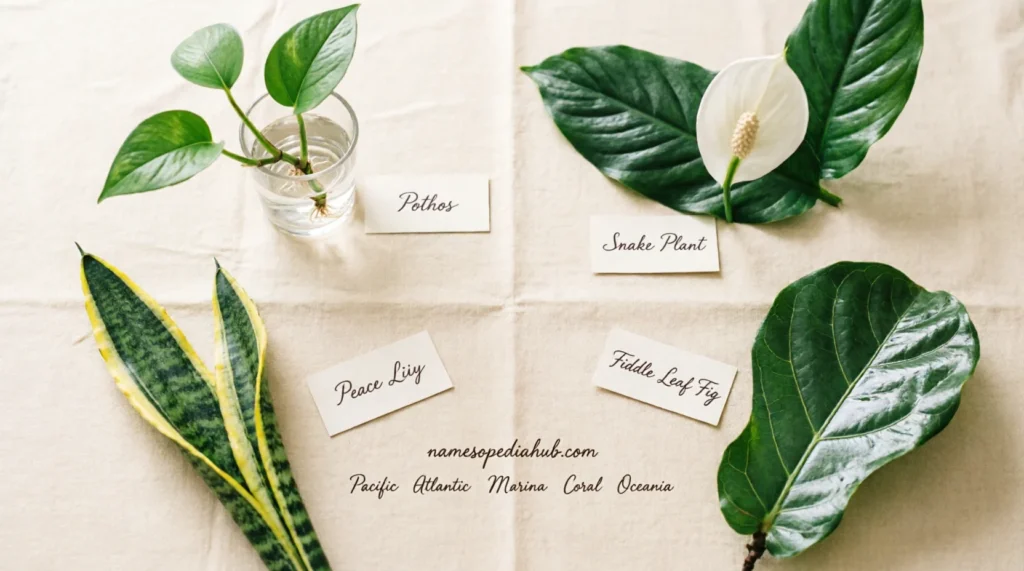
Pothos (Epipremnum aureum)
The Pothos is the plant world’s golden retriever universally loved, almost impossible to kill, and somehow always happy to see you. Its name comes from the Greek word for “longing,” which feels fitting for a plant that trails and reaches toward any light it can find.
Common varieties carry their own personalities: Golden Pothos is classic and cheerful, Marble Queen feels elegant and editorial, Neon Pothos is unapologetically bold, and Manjula has a quiet, dappled beauty that rewards closer looking.
Vibe: Warm, accessible, enduring. The plant equivalent of a cozy cardigan.
Mons tera ( Mons tera deliciosa )
Few houseplants carry as much cultural weight as the Monstera. Its name comes from the Latin monstrum meaning monster a reference to its dramatically perforated leaves that look like something from a tropical fever dream.
The Monstera became the defining plant of the 2010s aesthetic, splashed across wallpaper, tote bags, and every third Instagram post about “clean living.” But its popularity isn’t hollow this is genuinely one of the most architecturally beautiful plants in existence.
Monstera deliciosa
is the classic(the Swiss Cheese Plant) has more holes, smaller scale, and an almost lace-like quality. Monstera Thai Constellation is a rare variegated form that sells for hundreds of dollars and has the visual drama of a galaxy.
Vibe: Tropical maximalism. Confident, lush, and unapologetically photogenic.
Snake Plant (Dracaena trifasciata, formerly Sansevieria)
The Snake Plant has lived under many names Sansevieria, Mother-in-Law’s Tongue, Saint George’s Sword, Viper’s Bowstring Hemp. Each one tells a slightly different story about how humans have perceived this striking, upright plant across centuries and cultures.
It’s been renamed by botanists (moved to Dracaena in 2017, to the confusion of everyone), but plant lovers still tend to call it Sansevieria out of sheer habit and affection. The common name “Snake Plant” references its pattern of scales; “Mother-in-Law’s Tongue” references its sharp, pointed tips. Neither is particularly flattering, but both are deeply memorable.
Varieties worth knowing: Laurentii (classic yellow-edged), Moonshine (silvery, ethereal), Black Gold (dark green with gold borders), Cylindrica (architectural, rod-like leaves).
Vibe: Stoic, architectural, quietly dramatic. The plant that thrives on neglect and never complains.
Peace Lily (Spathiphyllum wallisii)
The name says everything. Peace, Lily two words that together form a quiet, almost spiritual identity. This plant has long been associated with sympathy, hope, and gentle healing, which is why you’ll often find it in hospitals, offices, and the homes of people who want their spaces to feel calm.
The botanical name Spathiphyllum means “spathe leaf” a reference to the white hood-like bract that surrounds its flower spike. It’s less poetic than the common name, but it’s precise.
Vibe: Serene, empathetic, quietly elegant. This is the plant you give someone who needs comfort.
Fiddle Leaf Fig (Ficus lyrata)
The Fiddle Leaf Fig became the most aspirational plant of the 2010s interior design movement a towering, theatrical statement tree that graced every architectural digest cover and design blogger’s living room. Its name comes from its leaves, which resemble the body of a fiddle (or violin).
It’s notoriously dramatic. Drop in temperature? Leaves fall. Move it two feet? Leaves fall. Look at it wrong? Leaves might fall. And yet people adore it, precisely because of the effort it demands.
Vibe: High-maintenance, high-reward. The diva of the plant world, and worth every moment.
Soft & Romantic Plant Names For Cottagecore and Boho Spaces
If your aesthetic leans toward linen curtains, dried florals, and afternoon light through old windows, these plant names will feel like coming home.
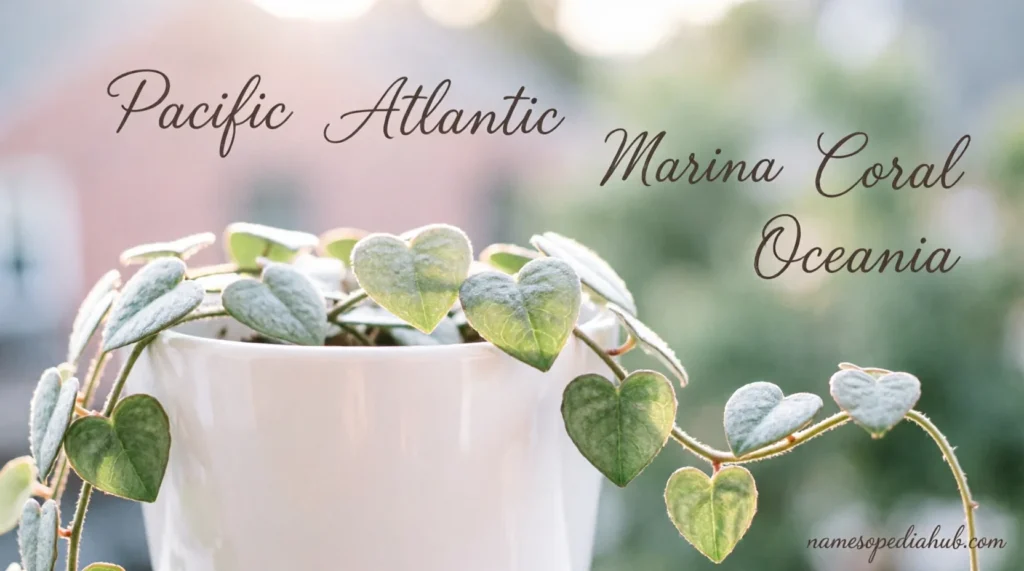
String of Hearts (Ceropegia woodii)
The name String of Hearts is almost unbearably romantic, and the plant earns it completely. Tiny, silver-marbled heart-shaped leaves cascade down like a living piece of jewelry. It’s the plant equivalent of a love letter delicate, trailing, tender.
Originally from South Africa, it’s been collected and adored for generations. On TikTok’s #PlantTok, it regularly goes viral among younger plant parents drawn to its dainty visual drama.
String of Pearls (Senecio rowleyanus)
Spherical, bead-like leaves string together like a piece of vintage jewelry. The name is perfect the plant genuinely looks like pearls, and it drapes over shelves and hanging pots with a graceful, almost liquid quality.
It’s delicate despite looking whimsical, preferring bright light and careful watering. The reward for its care is a plant that feels genuinely magical.
Baby Tears (Soleirolia soleirolii)
A carpet of impossibly tiny, round leaves on thread-thin stems Baby Tears is a name that somehow captures the visual experience perfectly. It spreads in a lush, moss-like mat that looks like the floor of a fairy forest.
Also known as Angel’s Tears and Paddy’s Wig, it carries multiple tender, almost melancholy names.
Heartleaf Philodendron (Philodendron hederaceum)
Simple, affectionate, unfussy the Heartleaf Philodendron is a trailing plant with glossy heart-shaped leaves. Its name is direct and sweet. Unlike the more complicated Philodendron relatives (the massive gloriosum, the velvet-textured micans), this one wears its identity plainly.
Begonia (Begonia spp.)
Named after Michel Bégon, a French governor and patron of botany but the name has long since transcended its origin. Begonias now evoke grandmother’s windowsills, Victorian parlors, and the particular warmth of a home that has always had plants in it. Varieties range from classic waxy-leafed types to the showstopping Rex Begonia, whose painted, swirling leaves look like abstract art.
Dramatic & Dark Plant Names For Moody, Gothic, and Statement Aesthetics
Not every plant parent wants soft and gentle. Some of us want drama. Mystery. A plant that looks like it belongs in a dark academia library or a Victorian greenhouse.
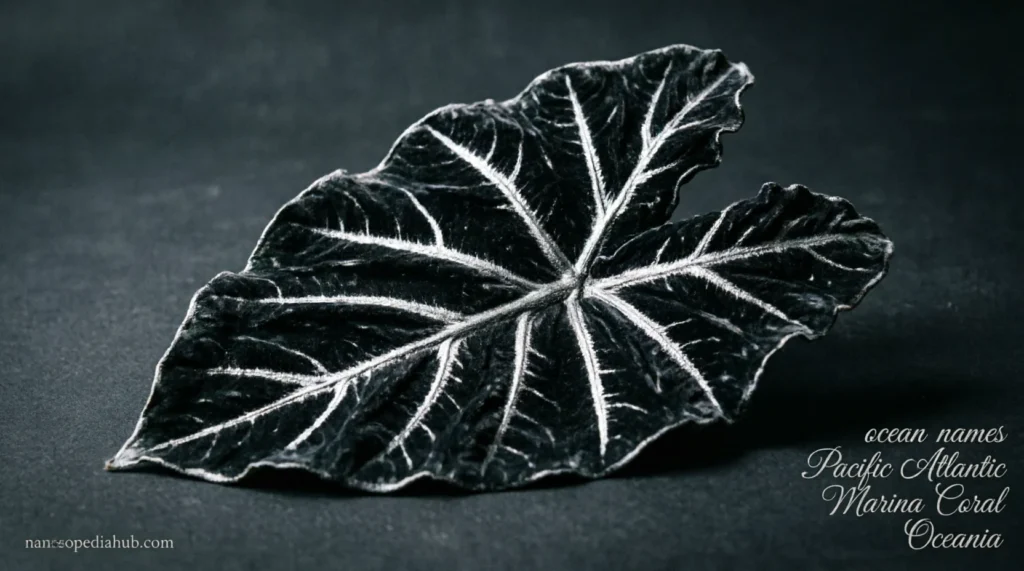
Black Velvet Alocasia (Alocasia reginula)
Alocasia reginula the name reginula means “little queen” in Latin, which sits in perfect tension with the plant’s almost ominous presence. Its leaves are a deep, velvety near-black with contrasting silver veins. It looks like it should belong to a witch, and it knows it.
The common name Black Velvet Alocasia earns its place touching the leaves genuinely does feel like velvet.
Vibe: Dark luxury. A plant for people who also own taxidermy and first-edition gothic novels.
ZZ Plant ‘Raven’ (Zamioculcas zamiifolia ‘Raven’)
The standard ZZ Plant is already dramatic glossy, waxy leaves on upright stems. But the Raven cultivar takes it somewhere else entirely. New growth emerges bright green, then slowly deepens to a near-black that’s genuinely unusual in the houseplant world.
The name Raven was perfectly chosen. It references Edgar Allan Poe without saying his name.
Black Cardinal Philodendron (Philodendron ‘Black Cardinal’)
Deep burgundy-to-black leaves that emerge as a striking bronze-green before darkening. The name Black Cardinal has the weight of religious iconography and royal authority, which suits the plant’s strikingly formal presence perfectly.
Cast Iron Plant (Aspidistra elatior)
One of the toughest plants in existence it survived the smoke-filled rooms of Victorian homes when gas lighting was common, which is why it became ubiquitous in that era. The name Cast Iron is a testament to its near-indestructibility. Neglect it, ignore it, give it almost no light it will endure.
Vibe: Stoic, Victorian, resilient. The plant equivalent of a soldier.
Dracaena ‘Marginata’ (Dracaena marginata)
Commonly called the Dragon Tree which tells you everything you need to know about its personality. Tall, spiky, multi-stemmed, with leaves edged in deep red. It has the sculptural drama of a fantasy plant and the eerie silence of something ancient.
Celestial & Mystical Plant Names For the Spiritually Inclined
Some plant names sound like they belong in a horoscope, a herbalist’s notebook, or the background of a tarot card. These are the ones.
Moonshine Snake Plant (Dracaena trifasciata ‘Moonshine’)
The palest, most ethereal variety of the Snake Plant its leaves are a cool, luminous silver-green that genuinely glows in low light. The cultivar name Moonshine was inspired, not manufactured. It looks exactly like moonlight.
Stardust Cactus (Mammillaria gracilis fragilis)
A small, clustering cactus covered in dense white spines that radiate in perfect patterns from a distance, it genuinely sparkles. The common name Stardust is one of the most visually accurate names in the plant world.
Galaxy Pothos (Epipremnum aureum ‘N’Joy’ or similar mottled varieties)
A newer collector name for heavily variegated Pothos types not always an official cultivar name, but used in plant communities to describe leaves that look like starfields.
Moonflower (Ipomoea alba)
While technically a climbing vine grown indoors by enthusiasts, the Moonflower is one of the most poetically named plants in cultivation. It blooms at night, opening pure white flowers that perfume the air in darkness.
Ghost Plant (Graptopetalum paraguayense)
Pale, blue-grey succulent rosettes that seem to fade in and out of visibility depending on the light. The name Ghost captures its translucent, barely-there quality beautifully.
Tropical & Lush Plant Names For Jungle Aesthetic Lovers
These are the plants that make a room feel like a rainforest canopy big, lush, and unapologetically alive.
Bird of Paradise (Strelitzia reginae / Strelitzia nicolai)
One of the most iconic houseplant names in existence. Strelitzia reginae produces flowers that genuinely look like tropical birds mid-flight bright orange and purple, emerging from a green sheath. The White Bird of Paradise (Strelitzia nicolai) is the massive, room-defining version that interior designers worship.
The name carries a particular weight. Bird of Paradise sounds like a destination, a promise, a state of being.
Elephant Ear (Alocasia, Colocasia, Xanthosoma spp.)
Several different plant genera share this common name all of them distinguished by their enormous, impressive leaves that genuinely do resemble the ears of an elephant. The name is affectionate and accurate, and these plants deliver on the drama.
Bird’s Nest Fern (Asplenium nidus)
A fern whose unfurling fronds emerge from a central rosette that resembles a bird’s nest rippled, bright green, and deeply satisfying. Asplenium nidus has one of the most poetic plant names in cultivation: nidus is Latin for “nest.”
Rubber Plant (Ficus elastica)
Named for the latex sap it produces historically used in rubber production before synthetic alternatives emerged. Today, it’s prized for its large, waxy, deep-green (or burgundy, in the Burgundy cultivar) leaves and its easy, unfussy presence in a home.
Calathea (Calathea spp., now partly reclassified as Goeppertia)
The Calathea family is famous for its extraordinary leaf patterns stripes, spots, and painted markings that look hand-drawn. Individual varieties have wonderful names: Rattlesnake Plant (Calathea lancifolia), Peacock Plant (Calathea makoyana), Pin-stripe Plant (Calathea ornata), Zebra Plant (Calathea zebrina). Every name in this family earns its reference.
Quirky & Playful Plant Names For the Fun-First Plant Parent
Some plant names exist purely to delight you. These are the ones you can’t say without smiling.
| Plant Name | Botanical Name | Why It’s Wonderful |
| Bunny Ear Cactus | Opuntia microdasys | Two oval pads that genuinely look like rabbit ears |
| Panda Plant | Kalanchoe tomentosa | Fuzzy, grey-green leaves with chocolate-brown tips |
| Ponytail Palm | Beaucarnea recurvata | A swollen trunk topped with a fountain of narrow leaves |
| Pickle Plant | Delosperma echinatum | Plump, spiny, cylindrical leaves that actually look like tiny pickles |
| Monkey Face Orchid | Dracula simia | Flowers with markings that uncannily resemble a monkey’s face |
| Corpse Flower | Amorphophallus titanum | Named for its infamous smell rarely bloomed indoors, but legendary |
| Hen and Chicks | Sempervivum tectorum | A mother rosette surrounded by smaller offshoots the names describe it perfectly |
| Donkey’s Tail | Sedum morganianum | Fat, trailing, blue-green leaves that tumble like a tail |
| Old Man Cactus | Cephalocereus senilis | Covered in long white hairs that genuinely suggest an old man’s beard |
| Cow Tongue Plant | Gasteria lingua | Flat, tongue-shaped leaves the name is unfortunately accurate |
Botanical Latin Names Worth Knowing And What They Mean
Botanical names tell stories. Once you understand the system, Latin names stop being intimidating and start being a form of poetry.
| Botanical Name | Common Name | What the Latin Means |
| Monstera deliciosa | Swiss Cheese Plant | “Delicious monster” edible fruit, dramatic leaves |
| Strelitzia reginae | Bird of Paradise | Named for Queen Charlotte of Mecklenburg-Strelitz |
| Philodendron | Many varieties | “Tree lover” in Greek refers to its climbing habit |
| Epipremnum aureum | Golden Pothos | “Upon the trunk, golden” |
| Asplenium nidus | Bird’s Nest Fern | “Nest” perfectly descriptive |
| Ceropegia woodii | String of Hearts | Named for botanist John Medley Wood |
| Zamioculcas zamiifolia | ZZ Plant | “Zamia-like leaves” a mouthful, lovingly shortened |
| Spathiphyllum wallisii | Peace Lily | “Spathe leaf” references its flower structure |
| Ficus lyrata | Fiddle Leaf Fig | “Lyre-shaped” referring to the leaf silhouette |
| Dracaena trifasciata | Snake Plant | “Three-banded” describing its leaf markings |
How to Name Your Houseplant (As a Pet)
Naming a houseplant as an individual companion giving it a personal name is a genuinely growing trend. Plant parents on TikTok, Reddit’s r/houseplants, and Pinterest regularly share their plants’ names alongside their care routines.
The psychology behind it makes sense. Naming something deepens your relationship to it. You’re more likely to water a plant named Gerald than a plant that is simply “the Pothos in the kitchen.”
Name ideas by plant personality:
Snake Plants: Sansa, Spear, Vera, Rex, Aster, Blade, Sage Reasoning: Upright, stoic, formal names that carry similar energy
Pothos: Ivy, Nell, Dewey, Clover, Pippa, Wade, Bree Reasoning: Trailing, warm, easy-going names that feel relaxed and fond
Monsteras: Maxine, Atlas, Hugo, Cleo, Brutus, Ursula, Theo Reasoning: Large, dramatic, architectural names with presence
Peace Lilies: Lily (of course), Seraphina, Clara, June, Celia, Dove Reasoning: Serene, tender, quietly graceful
Cactus: Harold, Spike, Gertrude, Basil, Lancelot, Dotty Reasoning: Prickly on the outside, oddly charming names with personality
Succulents: Pebble, Biscuit, Wren, Tiny, Mochi, Pearl Reasoning: Small, round, satisfying names that feel affectionate and light
Rare & Collector Plant Names The Ones Plant Enthusiasts Hunt For
The world of rare houseplants has its own language names whispered in plant swap communities and bid on in online auctions for prices that would stun a non-plant person.
Monstera Thai Constellation A slow-growing variegated Monstera with creamy, constellation-like speckles across its leaves. Named for the star-pattern appearance of its variegation. One of the most sought-after houseplants of the 2020s.
Philodendron gloriosum Gloriosum means “glorious” in Latin. The name is not hyperbole. Enormous velvety heart-shaped leaves with bright white veining, this plant has a presence like few others.
Variegated Monstera albo (Monstera deliciosa ‘Albo Variegata’) Pure white variegation in irregular, almost painterly patches. Has sold for thousands of dollars per cutting. The name albo simply means “white” in Latin.
Hoya kerrii The Sweetheart Hoya, named for its perfectly heart-shaped leaves. A single-leaf cutting is commonly sold around Valentine’s Day worldwide.
Anthurium clarinervium Velvety dark green leaves with dramatically contrasting white veins. Clarinervium means “clear-veined.” Collectors in the Anthurium community pursue this as a grail plant.
Begonia maculata The Polka Dot Begonia. Silver-spotted dark green leaves with deep red undersides it looks like something from a fantasy illustrator’s sketchbook. Enormous on social media.
Indoor Plant Names by Aesthetic A Quick Reference
Cottagecore & Soft Romantic String of Hearts, Baby Tears, African Violet, Maidenhair Fern, Cyclamen, Primrose, English Ivy, Heartleaf Philodendron
Dark Academia & Moody Black Velvet Alocasia, Raven ZZ, Black Cardinal Philodendron, Cast Iron Plant, Dragon Tree, Burgundy Rubber Plant, Black Bat Flower
Scandi Minimalist Pilea peperomioides, Air Plants (Tillandsia), White Orchid, ZZ Plant, Simple Succulent Arrangements, Aloe Vera
Jungle Maximalist Monstera deliciosa, Bird of Paradise, Elephant Ear, Banana Plant, Philodendron gloriosum, Bird’s Nest Fern, Calathea
Celestial & Mystical Moonshine Snake Plant, Ghost Plant, Stardust Cactus, Moonflower, Silver Torch Cactus, Starfish Cactus (Stapelia)
Vintage & Grandmillenial African Violet, Pothos, Spider Plant, Cast Iron Plant, Christmas Cactus, Begonia, Geranium, Rubber Plant
FAQs About Indoor Plant Names
What is the most popular indoor plant?
The Pothos (Epipremnum aureum) is widely considered the world’s most popular houseplant due to its extreme adaptability, low-care needs, and trailing beauty. The Monstera and Snake Plant follow closely, particularly in the social media era.
What’s the difference between a common name and a botanical name?
A common name is the everyday name used in a specific language or region these can vary wildly. A botanical (Latin) name is standardized globally: every scientist, grower, and botanist in the world uses the same Latin name for the same plant. Knowing the Latin name eliminates confusion.
Why do some plants have multiple common names?
Plants acquire common names organically through regional use, cultural associations, and physical descriptions so the same plant can have completely different names in different places. The Snake Plant is also called Mother-in-Law’s Tongue, Saint George’s Sword, and Viper’s Bowstring Hemp depending on where you are.
What are good names to give a pet houseplant?
Names that match your plant’s personality work best. For dramatic plants like Monsteras, big names feel right Hugo, Maxine, Atlas. For trailing, gentle plants like Pothos, something warm and easy Ivy, Nell, Dewey. The best pet plant name is the one that makes you smile when you say it.
What are the easiest indoor plants with beautiful names?
Snake Plant, Pothos, ZZ Plant, Peace Lily, Spider Plant (Chlorophytum comosum), and Aloe Vera (Aloe barbadensis miller) are among the easiest to grow and all have names worth knowing.
Are botanical names hard to learn?
Less than you’d think. The trick is learning the descriptive ones first aureum (golden), nidus (nest), deliciosa (delicious), gloriosum (glorious). Once you understand what the words mean, the names start to feel intuitive rather than intimidating.
A Final Word: The Plant That Feels Like It Has Your Name on It
There’s a moment every plant parent knows when you see a plant and something in you just recognizes it. Maybe it’s the velvety darkness of a Black Velvet Alocasia that matches your aesthetic exactly. It’s a trailing String of Hearts that looks like the inside of a feeling you’ve been trying to describe. Maybe it’s just a cheerful Pothos in a yellow pot, and it makes your kitchen feel like a home.
Names are part of that recognition. When you know what a plant is called its common name, its Latin name, its collector nickname, the name you’ve given it personally you deepen the connection. You move from owner to companion.
The best indoor plant name isn’t necessarily the most beautiful or the most scientifically accurate. It’s the one that makes you feel something. That makes the plant more real, more alive, more yours.
Go find your plant. You’ll know its name when you see it.

I am Clara Bennett, a passionate Name Researcher and Content Writer at Nameopediahub.com . I share well-researched content about name meanings, origins, trends, and naming ideas to help readers discover unique and meaningful names from around the world. nameopediahub.com