Surnames that carry centuries of elegance, authority, and quiet magnificence
Some last names enter a room before the person does.
You hear Ashford and immediately picture tall windows, old portraits, a library with a ladder that slides along the shelves. Mention Montclair and think of a French estate at dusk, somebody important signing something important with a very good pen.
You hear Blackwood and feel the weight of old decisions made in paneled rooms by people who understood exactly what they were doing.
That’s the specific magic of regal last names and it works whether you’re naming a character, choosing a pen name, building a fictional dynasty, researching your own family history, or simply fascinated by the architecture of names that carry genuine authority.
Regal surnames aren’t just old. Plenty of old names feel tired rather than grand. The ones that carry true regality have a specific quality, a combination of sound, origin, historical resonance, and cultural weight that makes them feel elevated without being absurd. They feel earned. They feel like something was built under them.
This guide explores the full spectrum: real aristocratic surnames from British, French, European, and global noble traditions; invented but phonetically convincing regal names for fiction and OC use; and the deeper principles that make a surname feel genuinely royal versus merely old-fashioned.
By the end, you’ll understand not just what these names are but why they feel the way they do.
QUICK ANSWER
Regal last names are surnames that evoke nobility, aristocracy, and inherited authority through their sound, origin, and historical associations. Classic examples include Ashford, Montague, Sinclair, Beaumont, Vane, Cavendish, Blackwood, Hargrove, Wyndham, and Fitzwilliam. These names appear across British peerage, French nobility, European royal houses, and fictional aristocratic traditions. They work for baby naming, character creation, pen names, and worldbuilding wherever a name needs to carry quiet, undeniable weight.
What Actually Makes a Last Name Feel Regal
This is the question most naming articles skip entirely and it’s the most important one to answer before you look at any list.
Regality in a surname isn’t random. It’s the product of specific, identifiable qualities that work together to create an impression of authority, elegance, and historical depth. Once you understand these qualities, you can evaluate any surname or even build your own with real confidence.
The Four Pillars of a Regal Surname
Historical association with nobility. Real surnames that were carried by actual aristocratic families carry automatic weight. Cavendish, Wyndham, Beaumont these names appear in the historical record as titles, estates, and peerage designations. That documented history transfers to the name itself.
Phonetic elegance. Regal surnames tend to have specific sound qualities: soft opening consonants (V, W, B, M, F), long vowel sounds, and smooth endings (-ford, -vale, -mont, -clair, -wood, -wick). They flow rather than stop. They sound considered rather than accidental.
The right number of syllables. Two to three syllables is the sweet spot. One syllable can work (Vane, Grey, Hale) when the sound is strong enough. Four syllables usually tips from grand into unwieldy. Wyndham: perfect. Beaumont: perfect. Fitzwilliam-Hartington: a bit much for daily use.
Latinate, French, or Old English roots. These linguistic traditions carry the longest association with European nobility. Latin surnames suggest Roman-era prestige or ecclesiastical authority. French-origin surnames signal Norman conquest lineage the surnames that came to England with William the Conqueror in 1066 and immediately became the ruling class. Old English surnames from place-names or estates suggest landed gentry with ancient territorial claims.
The absence of obviousness. The most interesting regal surnames don’t announce themselves as royal. They simply are. Blackwood doesn’t say “I am aristocratic.” It says “I have always been here, and the trees on my land are very old.” That restraint is crucial.
What Regal Surnames Are Not
They’re not merely old. Agnes Smith has been around since the 14th century and carries no particular regality.
They’re not necessarily hyphenated. The double-barrel name (Pemberton-Vane, Harrington-Smythe) can feel regal, but it can also feel like it’s trying too hard. Restraint often reads as more authentically aristocratic than elaboration.
They’re not exclusively British. French, Italian, Russian, Japanese, and other cultural traditions have their own deep vocabularies of noble surnames and those names carry exactly as much regal weight within their traditions.
Classic British Aristocratic Last Names
British peerage surnames are the global gold standard of regal naming partly because of the extraordinary reach of British cultural influence, and partly because the British class system documented its aristocratic surnames with obsessive thoroughness over several centuries. These names appear in Debrett’s Peerage, in Jane Austen novels, in Downton Abbey, and in the actual House of Lords.
The Finest British Aristocratic Surnames
Cavendish One of the great ducal surnames of England, associated with the Dukes of Devonshire since the 16th century. The Cavendish family’s history intersects with almost every major moment in British political and social history. As a name, it has a clean, authoritative sound with three syllables that land with quiet confidence. CAV-en-dish.
Wyndham From an Old English place-name, Wyndham has been associated with English gentry and nobility for centuries. It appears in literature (Wyndham Lewis, John Wyndham the sci-fi author) and in aristocratic registers alike. There’s a slightly melancholy elegance to it the kind of name that belongs in a country house with more rooms than anyone uses.
Pemberton Old English origin, meaning “from the settlement by the hill.” As a surname, it carries the specific quality of English landed gentry old enough to be historical, clean enough to feel current. Works beautifully in both period and contemporary settings.
Ashford Place-name surname meaning “ford by the ash trees.” The combination of a nature element (ash, one of Britain’s most historically significant trees) with the -ford suffix (suggesting a crossing point, a place of passage) gives it both natural grounding and aristocratic elevation. Currently experiencing a quiet revival in fiction and character naming.
Hargrove Old English, meaning “hare grove.” Three syllables, smooth throughout. Sounds like a family that has owned the same land for eight generations and knows the name of every field on it. Quietly, confidently upper-class.
Vane One syllable of pure aristocratic restraint. Sir Henry Vane was a significant 17th-century English statesman. As a surname, Vane has the quality of old families who don’t need elaboration. They’ve been here long enough that a single syllable is sufficient.
Sinclair’s Scottish-origin surname derived from Saint-Clair-sur-Epte in Normandy the Sinclairs came to Britain with the Norman Conquest. Associated with Scottish earldoms, Knights Templar mythology, and a long tradition of Scottish noble families. It has both historical depth and a slightly mysterious quality that makes it endlessly appealing.
Wentworth Old English, meaning “winter enclosure.” Associated with English nobility and gentry since medieval times. Three syllables with a strong opening. The kind of name you’d find on a gatehouse plaque, slightly weathered, absolutely legible.
Davenport Old English place-name meaning “settlement near the trickling stream.” Associated with English aristocracy and gentry. Three syllables of old-money English the kind of name that has its own family crest and a firm opinion about the correct way to address an envelope.
Cholmondeley Pronounced CHUM-lee (the spectacular gap between spelling and pronunciation is a feature, not a bug). This is one of Britain’s most authentically aristocratic surnames precisely because only people with genuine familiarity with British upper-class naming conventions know how to say it. The Cholmondeley family holds a hereditary marquessate.
| Surname | Origin | Associated Peerage | Sound Quality |
| Cavendish | Old English place | Dukes of Devonshire | Authoritative, clean |
| Wyndham | Old English place | Earls of Egremont | Elegant, slightly melancholy |
| Sinclair | Norman French | Earls of Caithness | Mysterious, noble |
| Pemberton | Old English place | Gentry | Grounded, distinguished |
| Davenport | Old English place | Gentry | Old-money, confident |
| Cholmondeley | Old English | Marquessate | Ultra-aristocratic |
| Wentworth | Old English | Gentry/nobility | Strong, historic |
| Vane | English | Baronetcy | Restrained, pure |
More Classic British Regal Surnames
- Fortescue Norman French origin, meaning “strong shield.” Associated with British legal and noble history.
- Featherington Long, slightly theatrical English place-name. Made fashionable by Bridgerton.
- Tremaine Cornish origin, meaning “town built on stone.” Ancient, regional, quietly noble.
- Huntington Old English, meaning “hunting estate.” Clean, strong, aristocratic.
- Clarendon is associated with the historic English earldom. Carries genuine peerage weight.
- Ponsonby Old French/English origin. Associated with Irish and British aristocracy. Unmistakably upper-class in sound.
French & European Noble Surnames With Regal Weight
British aristocratic surnames dominate most regal name lists but French, Italian, Spanish, and broader European noble traditions offer surnames of equal or greater beauty. The Norman conquest of 1066 actually makes French and British aristocratic naming traditions deeply intertwined.
French Aristocratic Surnames
Beaumont Old French, meaning “beautiful mountain.” Used extensively in both French and British noble families. The combination of beauty and elevation in its literal meaning mirrors its social associations perfectly. Currently one of the most elegant usable French-origin surnames in fiction and character naming.
Montclair French, meaning “bright mountain” or “clear mountain.” The -clair element adds luminosity to the elevation of Mont-. Sounds exactly like a French château name, which it essentially is. Used in contemporary fiction and period drama with consistent success.
Vauclaire A French-style invented or rare compound (from elements suggesting “valley” and “clarity/brightness”). The V opening gives it immediate elegance. Sounds like a wine estate or a minor French noble house that survived the Revolution with its dignity intact.
Delacroix French, meaning “of the cross.” Associated with the painter Eugène Delacroix, and before him with French aristocratic and religious heritage. The de- prefix is a marker of French noble origin families with de in their name were typically of noble or genteel descent.
Chevallier French variant of “chevalier,” meaning knight. Carries the chivalric tradition of French medieval nobility. Has a slightly romantic, courtly quality.
Fontaine French, meaning “fountain” or “spring.” Associated with French noble and literary traditions. Lighter in feel than most regal French surnames more lyrical than authoritative, but no less refined.
Renault Old French, meaning “counsel power.” Distinct from the car brand’s associations in a period or fantasy context. Has genuine French aristocratic history.
Villeneuve French, meaning “new village” or “new town.” Despite the modest literal meaning, Villeneuve became a surname associated with French nobility one of those names where the social meaning has long since overtaken the literal one.
Italian Noble Surnames
Visconti One of the great dynastic surnames of medieval Italy. The Visconti family ruled Milan from the 13th to the 15th century. As a surname it carries extraordinary historical weight and a slightly operatic quality that suits period fiction, fantasy aristocracy, and characters of Italian descent.
Monteverdi Italian, meaning “green mountain.” Associated with Claudio Monteverdi, one of the most important composers in Western musical history. Carries both noble and artistic prestige.
Ferrante Italian/Spanish origin, from the given name Fernando. Associated with the Ferrante dynasty of Naples. Currently enjoying cultural attention due to Elena Ferrante’s Neapolitan novels, giving it both historic and literary currency.
Castellano Italian/Spanish, meaning “of the castle” or “castle keeper.” Suggests both architectural authority and territorial ownership.
German & Austrian Aristocratic Surnames
The German von prefix (meaning “of” or “from”) marks noble origin, as de does in French. Von Richter suggests “of the judge” combining nobility with legal authority.
Waldenburg German, meaning “forest fortress.” Deeply atmospheric and imposing. Suits Gothic, dark fantasy, and Austrian imperial settings.
Hohenberg German, meaning “high mountain.” Associated with the Austro-Hungarian aristocracy. Sounds both majestic and slightly forbidding.
Regal Last Names for Fiction, OCs & Worldbuilding
This is where the list expands beyond historical accuracy into creative application. Whether you’re writing a fantasy novel, building a royal family for a story, creating an OC for a fanfiction, or designing a fictional noble house these names are curated for maximum narrative impact.
Invented Regal Surnames With Authentic Feel
The best invented regal surnames feel like they could be real; they follow the phonetic and structural patterns of actual aristocratic naming traditions while remaining usable without real-world baggage.
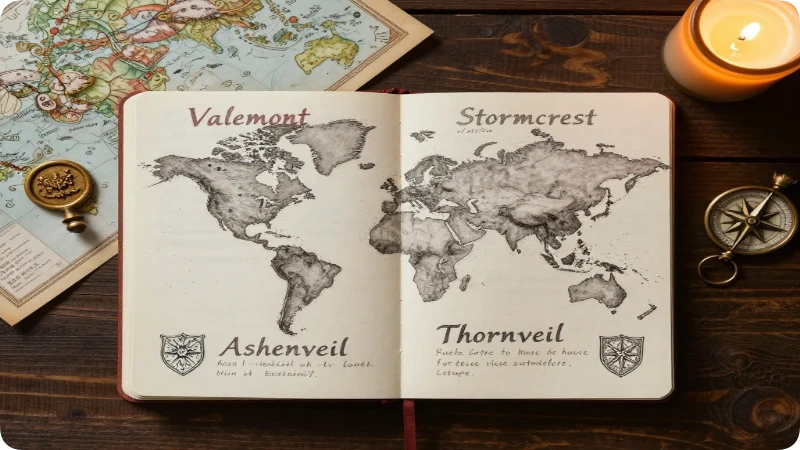
Ashenveil Ash (the ancient British tree, associated with nobility and magic) + veil (mystery, concealment). For a noble family with hidden history or dark secrets behind their elegant facade.
Valemont Vale (valley, suggesting landed territory) + mont (mountain, French elevation). Entirely invented but perfectly convincing as a French-origin noble surname.
Stormcrest Storm (power, unpredictability) + crest (heraldic symbol, peak). For a warrior noble house in fantasy settings. Sounds like a family whose banner features a lightning bolt.
Whitmore Old English origin (white moor), this one is actually real but rarely used. Clean, cold, aristocratic. The name of someone who presents a flawless surface to the world.
Duskaven Dusk (the liminal hour, neither day nor night) + haven (safe harbor). For a noble family in dark fantasy settings powerful, slightly ominous, associated with the boundary between states.
Goldenvane Gold (wealth, radiance) + vane (the real aristocratic surname). Invented but phonetically convincing as a minor noble house name.
Cravensworth Old English construction. Craven (a place in Yorkshire, also meaning “bold”) + worth (enclosed settlement). Sounds entirely authentic as a minor English aristocratic seat.
Thornveil Thorn (natural barrier, protection, beauty with danger) + veil (concealment). For a noble house that guards something a secret, a border, a power.
Everhart Germanic construction, meaning “brave/strong boar.” Sounds aristocratic without being ornate. Works for German-heritage fiction and realistic settings.
Rivenvale Riven (split, divided) + vale (valley). For a noble family whose history includes a great division, a war, a schism, a lost inheritance.
Regal Surnames by Story Genre
| Genre | Best Regal Surnames | Why They Work |
| Historical fiction (British) | Cavendish, Wyndham, Fortescue | Real peerage weight |
| Regency romance | Pemberton, Fitzwilliam, Davenport | Jane Austen-adjacent |
| High fantasy | Stormcrest, Ashenveil, Valemont | World-built nobility |
| Dark fantasy | Duskaven, Thornveil, Waldenburg | Gothic aristocratic |
| Contemporary drama | Sinclair, Ashford, Lennox | Modern prestige feel |
| Gothic fiction | Blackwood, Coldmere, Wraithmoor | Shadow and estate |
| Italian/European period | Visconti, Delacroix, Beaumont | Continental elegance |
| Sci-fi nobility | Valemont, Whitmore, Everhart | Clean, transferable |
Regal Last Names From Global Noble Traditions
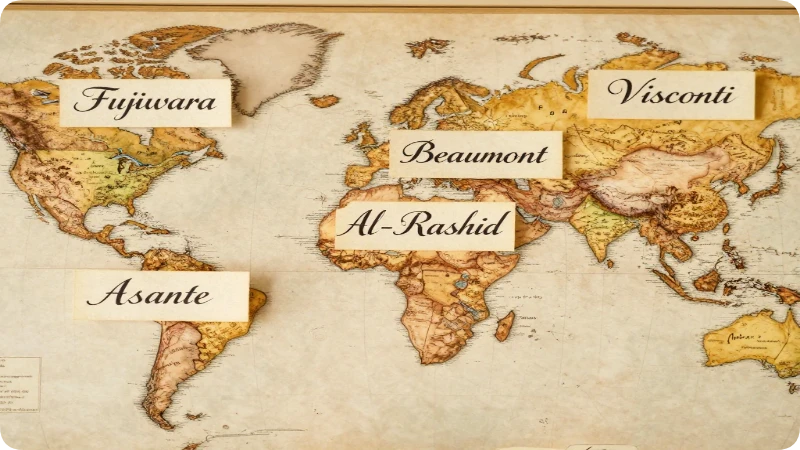
The aristocratic naming tradition is not exclusively European. Noble families across Asia, Africa, the Middle East, and the Americas developed their own surname traditions that carry equal and often greater historical depth and cultural authority.
Japanese Noble & Samurai Surnames
Japanese surnames from noble and samurai families carry a specific kind of regal weight often rooted in nature, geography, or poetic concepts, combined with an economy of expression that feels entirely different from European elaboration.
Fujiwara One of the most powerful aristocratic clans in Japanese history, the Fujiwara dominated the imperial court for centuries. The name means “wisteria plain” combining natural beauty with territorial possession in a distinctly Japanese way.
Minamoto The Minamoto clan was one of the four great clans of classical Japan. Their rivalry with the Taira clan defined an entire era of Japanese history. The name carries warrior-noble weight of the highest order.
Tachibana is associated with Japanese noble families, meaning “wild orange tree.” Elegant, nature-rooted, slightly melancholy in its aesthetic associations.
Konoe One of the five regent houses of Japan (the Gosekke), meaning “imperial guard.” Among the most genuinely aristocratic surnames in Japanese history.
Tokugawa The shogunal dynasty that governed Japan from 1603 to 1868. The name carries the weight of the Edo period, one of the most stable and culturally rich eras in Japanese history.
Arabic & Persian Noble Surnames
Al-Rashid Arabic, associated with the Abbasid Caliph Harun al-Rashid of One Thousand and One Nights fame. The name means “the rightly guided one” combining religious authority with temporal power.
Ibn Khaldun The ibn construction (meaning “son of”) is a marker of Arab naming tradition. Ibn Khaldun, the 14th-century historian and philosopher, gave this name extraordinary intellectual prestige.
Qajar The name of the Persian royal dynasty that ruled Iran from 1789 to 1925. Carries imperial weight in Persian cultural tradition.
African Royal Surnames
Asante From the Ashanti Empire, one of West Africa’s most powerful historical kingdoms. The name carries the weight of a sophisticated empire with documented artistic and military achievement.
Osei A royal name in the Ashanti tradition, carried by several Asantehene (Ashanti kings). Has clean, authoritative phonetics that carry well in any language.
Mansa From the Mandinka tradition, meaning “king” or “emperor.” Made globally famous by Mansa Musa, the 14th-century ruler of the Mali Empire, considered one of the wealthiest individuals in recorded history.
Regal Last Names by Aesthetic Category
Dark & Gothic Aristocratic
For characters and settings where nobility comes with shadow, secrets, and the weight of very old decisions:
- Blackwood Real English surname. Dark, forested, entirely atmospheric. The name of an estate where something happened that nobody discusses.
- Ravenswood Ravens (dark intelligence, omens) + wood (territorial possession). Gothic aristocratic at its finest.
- Coldmere Cold + mere (still water). Emotional inaccessibility as a family name.
- Duskaven Invented. Liminal power, noble and ominous.
- Nighthollow For the noble house that rules the dark spaces. Fantasy and gothic horror settings.
- Vesper Evening star. Quiet darkness with theological resonance.
Soft & Romantic Aristocratic
For regency romance, romantic fiction, and aristocratic characters whose power is expressed through grace rather than force:
- Beaumont Beautiful mountain. French elegance, warm and luminous.
- Fontaine Spring/fountain. Light, lyrical, refined.
- Hargrove Gentle English nature. Old land, quiet authority.
- Vauclaire Valley brightness. French-style, romantic and clear.
- Ashford Ash and Ford. Natural, grounded, quietly beautiful.
- Wyndham Slightly melancholy English elegance. Country houses and old rain.
Powerful & Imposing Aristocratic
For characters whose regal quality is expressed through authority, power, and the suggestion of real historical force:
- Cavendish Ducal authority. Clean and commanding.
- Visconti Italian dynastic power. Operatic and absolute.
- Waldenburg German forest fortress. Heavy and atmospheric.
- Stormcrest Invented warrior-noble. Power and heraldry.
- Montclair French elevation. Bright and authoritative.
- Sinclair Norman depth. Mystery and noble weight.
Minimalist Regal (One or Two Syllables)
For regal surnames that achieve their effect through restraint:
- Vane One syllable of pure aristocratic compression.
- Grey Used as a surname by English noble families (the Grey family produced Lady Jane Grey). Clean, cool, historically weighted.
- Ash Tree name with ancient British associations. Minimal and strong.
- Morne From the French morne (gloomy, dark). One syllable of gothic minimalism.
- Clare From the medieval English earldom. Saint’s name, place name, noble name.
- Lorne Scottish noble surname. One syllable, Highland weight.
How to Choose the Right Regal Surname for Your Purpose
The right regal surname depends entirely on what you’re trying to achieve and who or what will carry it. Here’s a practical framework:
For Fiction & Character Creation
Match the world’s cultural logic first. A Japanese-heritage character in a realistic contemporary setting doesn’t get a French aristocratic surname unless there’s a specific narrative reason. Get the cultural root right, then choose for sound and resonance.
Consider the character’s relationship to their own regality. A character who wears their noble name with pride needs something authoritative: Cavendish, Visconti, Montclair. A character who has fled or rejected their noble origins needs something that suggests the weight they’re carrying despite themselves Blackwood, Vane, Wyndham.
Test it with the first name three times. Say the full name aloud. Then again more quickly. Then imagine a secondary character introducing them: “May I present Lord/Lady [surname].” If it doesn’t work in all three contexts, keep looking.
For Pen Names
Regal pen names work by creating a sense of authority and distinctiveness that supports your brand as a writer. The key is balance too obviously aristocratic and it reads as pretentious; too subtle and the effect is lost.
Sweet spot examples: V. Ashford, C. Wyndham, J. Sinclair. The initial-plus-regal-surname format is the cleanest and most convincing.
For Baby Names
Using a regal surname as a given name is a well-established tradition (think: Ashford, Lennox, Sinclair, Monroe). The key consideration is whether the name will serve the child across all life stages as a toddler, a teenager, or a professional adult. Cavendish as a first name may be a burden; Lennox as a first name works beautifully.
| Purpose | Best Approach | Top Picks |
| Fantasy noble house | Invented + phonetically convincing | Valemont, Stormcrest, Ashenveil |
| Historical fiction | Real documented peerage name | Cavendish, Wyndham, Fortescue |
| Contemporary fiction | Real but not overused | Sinclair, Ashford, Lennox |
| Pen name | Initial + regal surname | Wyndham, Sinclair, Vane |
| Character with dark past | Gothic aristocratic | Blackwood, Coldmere, Vesper |
| OC in regency setting | Jane Austen-adjacent | Pemberton, Davenport, Hargrove |
| Anime/fantasy OC | Japanese noble | Fujiwara, Tachibana, Minamoto |
Frequently Asked Questions
What are the most regal-sounding last names?
The most universally recognized regal last names include Cavendish, Wyndham, Sinclair, Beaumont, Montclair, Blackwood, Vane, Ashford, Pemberton, and Fortescue. These names combine genuine aristocratic history with phonetic elegance, the specific combination of sound and origin that creates an impression of inherited authority and quiet power.
What last names sound like old money?
Last names that evoke old money specifically (as opposed to general regality) tend to be English place-name surnames associated with landed estates: Cavendish, Davenport, Hargrove, Wentworth, Cholmondeley, Pemberton, and Clarendon. French-origin surnames with the de- prefix Delacroix, de Vere, de Beaumont also carry old-money associations from their Norman conquest heritage.
What are good regal last names for fictional characters?
For fiction, the best regal surnames depend on genre and setting. In British period fiction: Cavendish, Wyndham, Fortescue. For fantasy nobility: Valemont, Stormcrest, Ashenveil, Thornveil. In dark or gothic settings: Blackwood, Coldmere, Duskaven. For Italian or European period fiction: Visconti, Beaumont, Montclair. The key is matching the surname’s cultural origin to the world’s logic.
Are there regal last names from non-European traditions?
Absolutely. Japanese noble surnames include Fujiwara, Minamoto, Tachibana, and Konoe carrying centuries of imperial court and samurai aristocratic history. Arabic noble naming includes Al-Rashid and various ibn-constructions. African royal traditions include Osei (Ashanti), Asante, and Mansa (Mandinka). Ottoman noble surnames carry their own deep regal tradition. Non-European regal surnames often carry equal or greater historical depth than their European equivalents.
What makes a surname sound aristocratic?
Aristocratic surnames typically share several qualities: French or Latin-origin roots (especially if they arrived in England via the Norman Conquest), smooth phonetics with soft opening consonants and long vowel sounds, two to three syllables, place-name structure suggesting territorial ownership, and a certain restraint they don’t announce themselves as noble, they simply are. The -ford, -mont, -vale, -wood, -clair, and -wick suffixes are particularly associated with aristocratic English naming.
What are good regal last names for fantasy worldbuilding?
For high fantasy, invented surnames that follow aristocratic phonetic patterns work best: Valemont, Stormcrest, Ashenveil, Duskaven, Rivenvale, Goldenvane, Thornveil. For fantasy with real-world cultural roots, draw from the appropriate tradition’s actual noble surnames Fujiwara for Japanese-inspired settings, Visconti for Italian Renaissance-inspired worlds, Cavendish or Wyndham for British-adjacent fantasies.
The Names That Carry the Weight of What Was Built Under Them
A regal surname isn’t just a collection of syllables. It’s the compressed history of people who built something land, power, tradition, legacy and attached a name to it that their descendants would carry forward.
When you choose a name like Cavendish or Wyndham or Beaumont, you’re borrowing that compression. You’re reaching back into centuries of human ambition and inheritance and pulling something forward into your story, your character, your page.
The best regal surnames don’t feel chosen. They feel inherited. They feel like something that was always going to be there, waiting, already belonging to the person who finally claims them.
That’s the difference between a name that sounds regal and a name that is.
You know it when you find it. It settles. It stops being a name you picked and starts being a name that fits the way old wood fits old joints, the way a family crest fits an old gate, the way a title sounds after someone has finally earned it.
Find the name that feels like it was already yours.

I am Clara Bennett, a passionate Name Researcher and Content Writer at Nameopediahub.com . I share well-researched content about name meanings, origins, trends, and naming ideas to help readers discover unique and meaningful names from around the world. nameopediahub.com