There’s something almost magical about the names of musical instruments. Say “cello” out loud. Now say “sitar.” Now “theremin.” Each word carries its own texture, its own emotional fingerprint. Some names feel ancient and rooted, others light and playful, others dark and mysterious.
If you’re here because you’re curious about instrument names, researching for a project, looking for baby name inspiration, or building a world where music matters you’ve landed in the right place.
This isn’t just a list. It’s a journey through sound, culture, history, and the beautiful complexity of what it means to make music.
Featured Snippet Answer:
Musical instrument names come from a wide range of languages including Latin, Italian, Arabic, Sanskrit, Greek, French, and indigenous languages from every continent. They are typically named after their sound, their inventor, their shape, or the culture that created them. Major categories include strings, woodwinds, brass, percussion, and keyboards.
| Category | Examples | Sound Character |
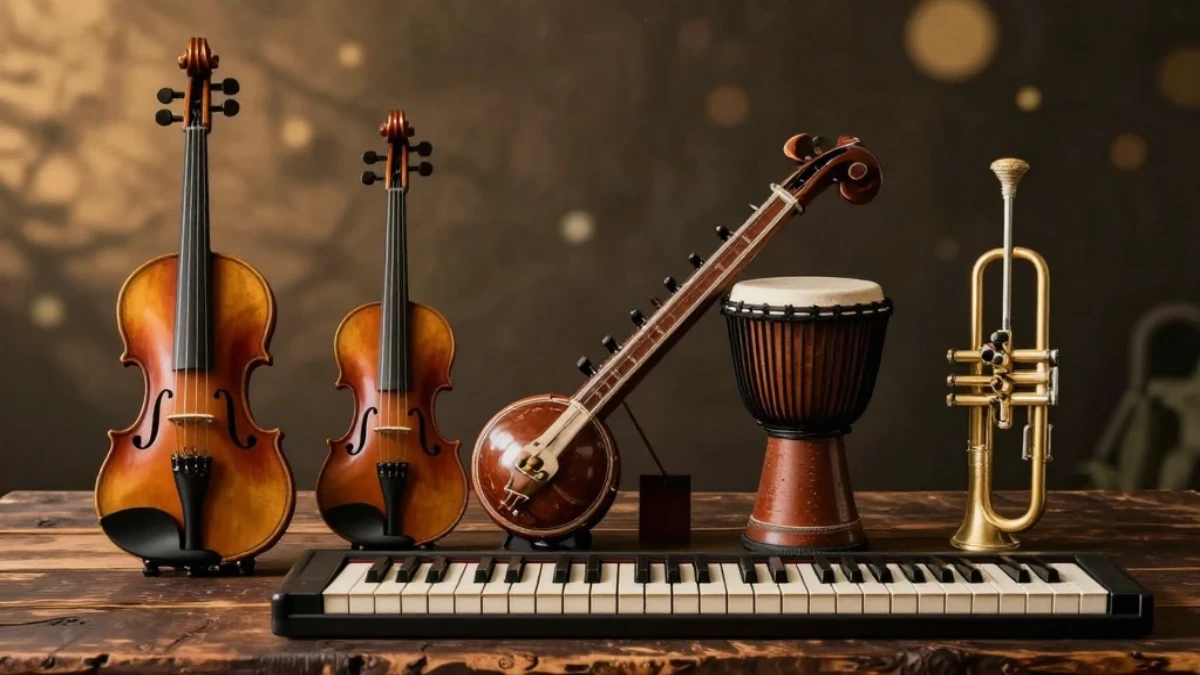
| String Instruments | Violin, Cello, Sitar, Oud, Koto | Warm, resonant, expressive |
| Woodwind Instruments | Flute, Oboe, Clarinet, Bassoon | Breathy, lyrical, versatile |
| Brass Instruments | Trumpet, Trombone, French Horn | Bold, powerful, ceremonial |
| Percussion Instruments | Drums, Tabla, Marimba, Xylophone | Rhythmic, driving, primal |
| Keyboard Instruments | Piano, Harpsichord, Organ, Synthesizer | Full, harmonic, architectural |
| Electronic Instruments | Theremin, Moog, Mellotron | Futuristic, eerie, limitless |
| Folk & World Instruments | Banjo, Didgeridoo, Balalaika, Mbira | Earthy, cultural, storytelling |
String Instruments: Names That Resonate Through Time

String instruments are arguably the most emotionally diverse family. Their names feel like poetry.
Violin
- Meaning: Diminutive of “viola” “small viol”
- Origin: Italian
- Language: Italian (from Medieval Latin vitula)
- Personality Vibe: Passionate, precise, soaring. The violin is the voice of the orchestra capable of heartbreak and triumph in the same phrase.
- Aesthetic Category: Classic elegance, romantic
- Cultural Relevance: Central to European classical music, Celtic folk, Indian classical (as violin entered Carnatic music in the 18th century), and modern pop crossover
- Nicknames: Fiddle (folk context), “the queen of instruments”
- Similar Names: Viola, Fiddle, Rebec (ancestor)
- Modern vs Classic Feel: Timeless equally at home in a Baroque chamber and a Yellowcard music video
- Trend Status: Perennially iconic; seeing a TikTok renaissance with viral classical crossover content
Cello
- Meaning: Short for violoncello “small violone” (large bass viol)
- Origin: Italian
- Personality Vibe: Deep, melancholic, warm. The cello is often described as the instrument closest to the human voice in its emotional range.
- Aesthetic Category: Romantic melancholy, dark warmth
- Pop Culture: The cello has become a symbol of emotional depth in film scores, think Hans Zimmer, YoYo Ma, or the haunting opening of Game of Thrones.
- Sibling Name Compatibility: Pairs beautifully as a baby name with Aria, Lyra, or Cadence
- Lucky Color: Deep burgundy, forest green
- Numerology: 6 nurturing, harmonious
Sitar
- Meaning: From Persian seh (three) + tar (string) “threestringed”
- Origin: Persian/Hindustani
- Language: Persian, adopted into Hindi/Urdu
- Cultural Relevance: Central to North Indian classical music; brought to Western pop consciousness by Ravi Shankar and The Beatles’ Norwegian Wood (1965)
- Personality Vibe: Meditative, complex, otherworldly. The sitar requires years of devotion and it rewards patience with unparalleled depth.
- Aesthetic Category: Psychedelic vintage, Eastern mysticism
- Trend Status: Experiencing aesthetic revival in lofi and world fusion music circles
Oud
- Meaning: Arabic alūd “the wood” or “the flexible stick”
- Origin: Arabic/Middle Eastern
- Cultural Relevance: The ancestor of the European lute; foundational to Arabic maqam music, Turkish classical, and North African traditions
- Personality Vibe: Ancient, soulful, haunting. The oud predates written music notation in many cultures.
- Aesthetic Category: Desert mysticism, ancient world
- Lucky Stone: Lapis lazuli fitting for an instrument that traveled the ancient Silk Road
Koto
- Meaning: The Japanese character 琴 refers to a zitherlike instrument
- Origin: Japan (adapted from Chinese guqin tradition)
- Personality Vibe: Serene, minimalist, meditative like a Zen garden translated into sound
- Aesthetic Category: Japanese minimalism, wabisabi
- Cultural Relevance: National instrument of Japan; deeply tied to court music (gagaku) and modern Japanese identity
Harp
- Meaning: From Old High German harpha related to “hook” (describing the shape)
- Origin: Germanic/Celtic
- Personality Vibe: Celestial, angelic, ethereal. No instrument conjures paradise quite like the harp.
- Aesthetic Category: Celestial, cottagecore, fairy tale
- Lucky Day: Friday (associated with Venus, goddess of beauty and music)
- Similar Names: Lyre (Greek ancestor), Arpa (Spanish/Italian)
- Trend Status: Hugely trending in fantasy aesthetics, Pinterest boards, and ethereal music playlists
Lute
- Meaning: From Arabic alūd via Old Provençal laut
- Origin: Arabic, developed in medieval Europe
- Personality Vibe: Renaissance romance, troubadour elegance, Shakespearean warmth
- Aesthetic Category: Medieval, historical fantasy, dark academia
Banjo
- Meaning: Likely derived from mbanza a Bantu (West African) string instrument
- Origin: AfricanAmerican, developed in the American South
- Personality Vibe: Joyful, earthy, communal. The banjo carries both the joy of bluegrass festivals and the weight of its complicated history.
- Aesthetic Category: Americana, folk revival, cottagecore
- Cultural Relevance: Central to Appalachian folk, bluegrass, and early jazz
Balalaika
- Meaning: Possibly from Turkish balabaн (loud noise) or from a Slavic root meaning “to chatter”
- Origin: Russia
- Personality Vibe: Festive, melancholic, distinctly Slavic it can sound like a party and a lament in the same song
- Aesthetic Category: Eastern European folk, cottagecore rustic
Woodwind Instruments: Names With Breath and Lightness
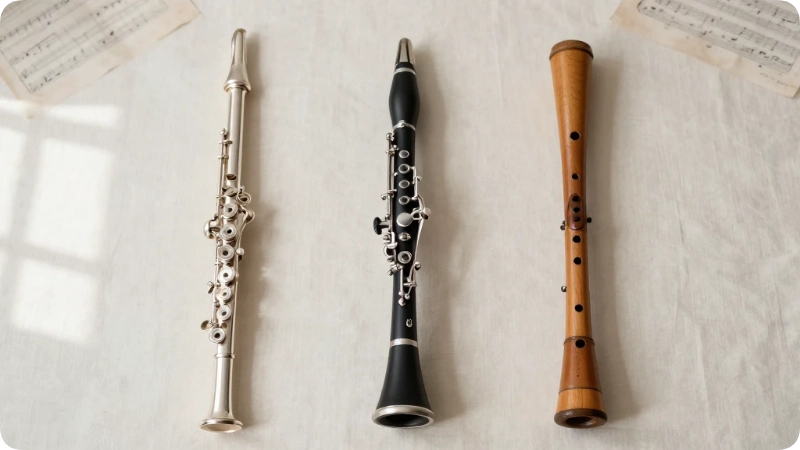
Woodwind names have an inherent airiness; most are short, smooth, and easy to say. That’s not a coincidence.
Flute
- Meaning: From Old French flaüte, possibly from Provençal flaüt
- Origin: French/Latin
- Personality Vibe: Light, graceful, crystalline. The flute is the soprano of the woodwind family.
- Aesthetic Category: Cottagecore, fairy, classical elegance
- Pop Culture: The flute has had a viral moment thanks to Lizzo, who plays piccolo flute (a smaller cousin) and has made it culturally cool again for a new generation
- Similar Names: Piccolo, Fife, Recorder
Oboe
- Meaning: From French hautbois “high wood” (haut = high, bois = wood)
- Origin: French
- Personality Vibe: Distinctive, slightly nasal, expressive the oboe is the instrument orchestras tune to because its pitch is so stable and penetrating
- Aesthetic Category: Old world refinement, dark academia
Clarinet
- Meaning: Diminutive of clarino (a type of trumpet) “little bright one”
- Origin: Italian/French
- Personality Vibe: Warm, flexible, conversational. The clarinet can whisper or wail it’s deeply at home in jazz, klezmer, and classical alike.
- Lucky Color: Sky blue
- Similar Names: Basset Horn, Bass Clarinet
Bassoon
- Meaning: From Italian fagotto (bundle of sticks) the French borrowed a different root; basson refers to the bass register
- Origin: Italian/French
- Personality Vibe: Dry, sardonic, warm the bassoon is the orchestra’s grandfather: deep, slightly grumpy, and absolutely essential
- Aesthetic Category: Dark academia, old world
Saxophone
- Meaning: Named after inventor Adolphe Sax + Greek phone (voice/sound)
- Origin: Belgian inventor, French naming convention
- Lucky Number: 5 freedom, sensuality, expression
- Personality Vibe: Smooth, seductive, urban cool. The saxophone practically invented the idea of “cool” in 20th century music.
- Aesthetic Category: Jazz noir, urban elegance, retro cool
- Trend Status: Experiencing a massive revival in indie pop, R&B, and “2010s nostalgia” aesthetics
Recorder
- Meaning: From Middle English recorder “to practice” or “to remember” (related to rehearsing music)
- Origin: English
- Personality Vibe: Humble, approachable, nostalgic every adult has a memory of playing recorder badly in elementary school, which is precisely its charm
Brass Instruments: Names With Weight and Power
Brass instrument names tend to be bold, openvoweled, and commanding just like the instruments themselves.
Trumpet
- Meaning: From Old French trompette diminutive of trompe (horn, trump)
- Origin: French/Germanic
- Personality Vibe: Triumphant, proud, declarative. Trumpets announce kings, begin battles, and open jazz sets. They have never been background instruments.
- Cultural Relevance: Appears in ancient Egypt, the Bible (shofar’s cousin), medieval Europe, and modern jazz equally
- Aesthetic Category: Royal, ceremonial, jazz cool
- Lucky Stone: Gold topaz
- Fictional Associations: Miles Davis’s trumpet in Kind of Blue is practically a fictional character itself
Trombone
- Meaning: Italian “large trumpet” (tromba = trumpet + one = augmentative suffix)
- Origin: Italian
- Personality Vibe: Warm, brazen, theatrical the trombone is the one brass instrument that slides between notes, giving it an almost vocal, human quality
- Aesthetic Category: Jazz, big band swagger
French Horn
- Meaning: Called cor (horn) in French “French horn” is actually a German instrument that the French developed in the 17th century
- Origin: Germany/France
- Personality Vibe: Noble, melancholic, huntingground romantic. French horn music sounds like autumn forests and distant memories.
- Aesthetic Category: Romantic era, noble wilderness, dark academia
Tuba
- Meaning: Latin simply means “tube” or “pipe”
- Origin: Latin
- Personality Vibe: Grounding, warm, slightly comic the tuba is the instrument that holds everyone else up while being perpetually underappreciated
- Lucky Color: Deep bronze
Percussion Instruments: Names That Pulse With Life
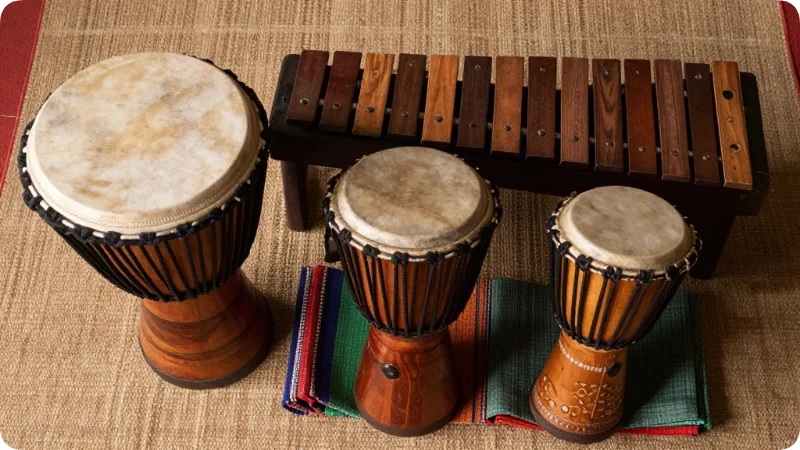
Percussion names tend to be onomatopoeic, rhythmic, or borrowed whole from their cultures of origin.
Tabla
- Meaning: From Arabic tabl “drum”
- Origin: Arabic, developed in the Indian subcontinent
- Language: Arabic/Hindi
- Cultural Relevance: The foundational percussion instrument of North Indian classical music; its mastery is a lifelong pursuit. Associated with Zakir Hussain, who brought tabla to global audiences.
- Personality Vibe: Intricate, meditative, conversational the tabla “talks” to the soloist in Indian classical performance
- Aesthetic Category: Eastern mysticism, classical depth
- Lucky Stone: Tiger’s eye
Djembe
- Meaning: From the Bamana phrase Anke djé, anke bé “everyone gather together in peace”
- Origin: West Africa (Mali, Guinea)
- Language: Bamana
- Personality Vibe: Communal, warm, celebratory. The djembe’s name is itself a philosophy, it’s an instrument designed to bring people together.
- Aesthetic Category: Earthy, communal, global folk
Marimba
- Meaning: Possibly from Bantu malimba (xylophonelike instrument) or from a combination of ma (belonging to) + rimba (single note xylophone bar)
- Origin: SubSaharan Africa, developed further in Central America (particularly Guatemala, where it is the national instrument)
- Personality Vibe: Warm, woody, joyful the marimba has a resonance that feels almost physical
- Aesthetic Category: Tropical warmth, folk celebration
Xylophone
- Meaning: Greek xylon (wood) + phone (sound/voice) “wood voice”
- Origin: Greek naming; instrument roots in Africa and Asia
- Personality Vibe: Bright, playful, slightly whimsical associated with childhood wonder and orchestral color
Kettle Drum (Timpani)
- Meaning: Timpani from Italian tympanum (drum), from Greek tympanon related to typtein (to strike)
- Personality Vibe: Majestic, theatrical, thunderous timpani are the earthquake of the orchestra
- Aesthetic Category: Baroque grandeur, cinematic power
Keyboard Instruments: Names of Architecture and Complexity
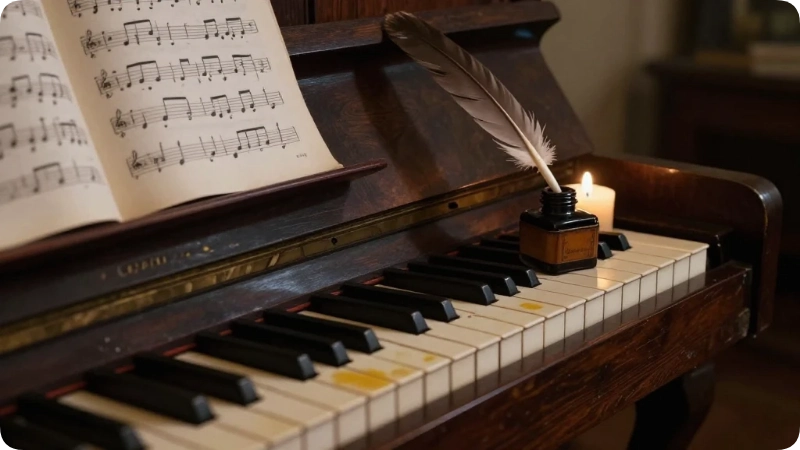
Keyboard instruments have names that feel architectural because they are. These are instruments as buildings, as systems, as machines.
Piano
- Full Name: Pianoforte “softloud” in Italian
- Meaning: Refers to the instrument’s revolutionary ability (compared to the harpsichord) to play at varying dynamic levels
- Origin: Italian, invented by Bartolomeo Cristofori around 1700
- Lucky Number: 7 spiritual, intellectual, seeking
- Lucky Stone: Clear quartz reflecting the piano’s clarity and range
- Personality Vibe: Versatile, introspective, powerful. The piano is the one instrument that can do almost everything: melody, harmony, rhythm, counterpoint alone.
- Aesthetic Category: Classic luxury, dark academia, modern minimalism
- Trend Status: Experiencing aesthetic revival on TikTok through “dark academia” piano content and viral classical covers
Harpsichord
- Meaning: From Italian arpicordo “harp string” (plucked string mechanism)
- Origin: Italian/Flemish
- Personality Vibe: Precise, crystalline, aristocratic the harpsichord is the piano’s elegant, slightly severe ancestor
- Aesthetic Category: Baroque, dark academia, historical fiction
Organ
- Meaning: From Greek organon “instrument, tool”
- Origin: Greek; the pipe organ was developed in ancient Greece and Rome
- Cultural Relevance: Deeply tied to Christian church music and Gothic cathedral architecture; also central to gospel, blues, and progressive rock
- Personality Vibe: Grand, spiritual, overwhelming in scale the organ is the most physically powerful acoustic instrument ever built
- Aesthetic Category: Gothic, sacred, progressive rock
Synthesizer
- Meaning: From Greek synthesis (putting together) it synthesizes (creates) sound electronically
- Origin: American, 20th century; Robert Moog’s 1960s instruments popularized the term
- Personality Vibe: Futurefacing, boundarydissolving, endlessly shapeshifting
- Aesthetic Category: Synthwave, futurism, cyberpunk, vaporwave
- Trend Status: Extremely trendy; central to hyperpop, lofi, and bedroom pop aesthetics
Electronic & Experimental Instruments: Names From the Future
Theremin
- Meaning: Named after inventor Léon Theremin (born Lev Sergeyevich Termen), a Russian physicist
- Origin: Soviet Russia, 1920
- Personality Vibe: Eerie, spectral, ghostly you play it without touching it, waving your hands through an electromagnetic field
- Aesthetic Category: Retro scifi, gothic, avantgarde
- Cultural Relevance: The sound of every 1950s scifi horror film; used by The Beach Boys in Good Vibrations; experiencing a huge revival in ambient and experimental music
Mellotron
- Meaning: A portmanteau of “melody” + “electron” a keyboard instrument that plays recordings of real instruments from magnetic tape
- Origin: British, 1963
- Personality Vibe: Nostalgic, dreamy, slightly haunted the Mellotron sounds like memory itself
- Aesthetic Category: Psychedelic, dreamy vintage, dark aesthetic
Folk & World Instruments: Names That Carry Culture
Didgeridoo
- Meaning: The name is onomatopoeic it mimics the sound the instrument makes; the Aboriginal word is yidaki (Yolŋu people of Arnhem Land)
- Origin: Australia (Aboriginal peoples, among the oldest instruments on Earth at ~1,500+ years old)
- Personality Vibe: Ancient, meditative, earthconnecting playing the didgeridoo involves circular breathing, making it one of the most physically demanding wind instruments
- Aesthetic Category: Primal, earthen, ancient world
Mbira
- Meaning: From the Shona language of Zimbabwe refers to the thumb piano or “hand piano”
- Origin: SubSaharan Africa (Zimbabwe, Southern Africa)
- Personality Vibe: Intimate, buzzing, hypnotic the mbira is played in spiritual ceremonies and is believed to connect the living with ancestral spirits
- Aesthetic Category: Spiritual folk, earthen mysticism
Shamisen
- Meaning: Japanese san (three) + gen/gen (string) literally “three strings”
- Origin: Japan (adapted from the Chinese sanxian via Okinawa’s sanshin)
- Personality Vibe: Sharp, dramatic, melancholic the shamisen is the sound of kabuki theater and Japanese storytelling
- Aesthetic Category: Japanese traditional, anime aesthetics, dark elegance
Bouzouki
- Meaning: From Turkish bozuk “broken” or “altered” (referring to a modified tuning)
- Origin: Greece (adapted from Ottoman Turkish instruments)
- Personality Vibe: Festive, passionate, distinctly Mediterranean the sound of Greek summer evenings and Irish folk revival equally
- Cultural Relevance: Iconic in Greek music; also adopted into Irish traditional music in the 1960s
Musical Instrument Names as Baby Names: A Growing Trend
Here’s something your search algorithm probably didn’t tell you: parents are increasingly using musical instrument names or instrument-inspired names for their children.
| Instrument Name | Baby Name Potential | Vibe | Notes |
| Lyra | Very High | Celestial, elegant | Already a Top 200 name in several countries |
| Aria | Very High | Operatic, graceful | Top 50 in the US technically an operatic term, not instrument |
| Viola | High | Vintage, artistic | Trending with the vintage name revival |
| Cello | Medium | Unique, musical | Used by musician parents |
| Banjo | Medium | Quirky, Americana | Used as a celebrity baby name |
| Fife | LowMedium | Uncommon, sharp | Interesting surnamestyle first name |
| Harp | Medium | Natureadjacent, soft | Gaining attention in ethereal name circles |
| Lute | Low | Medieval, bookish | Niche but charming for fantasy lovers |
| Sitar | Low | unfamiliar, spiritual | Used in South Asian communities |
| Koto | Low | Japanese, minimalist | Appealing crosscultural option |
Aesthetic Categories: Finding Your Instrument Name by Vibe
Not everyone comes to instrument names with the same energy. Here’s a breakdown by aesthetic:
Dark Academia: Harpsichord, Cello, Oboe, Bassoon, French Horn, Lute, Viola da Gamba
Celestial / Ethereal: Harp, Flute, Theremin, Koto, Lyra (lyre), Celestia (a small keyboard instrument)
Earthy / Folk: Djembe, Banjo, Mbira, Bouzouki, Didgeridoo, Fiddle, Dulcimer
Futuristic / Electronic: Synthesizer, Theremin, Mellotron, Vocoder, Moog
Royal / Ceremonial: Trumpet, Organ, Kettle Drum, French Horn, Lute
Japanese Aesthetic / AnimeAdjacent: Shamisen, Koto, Shakuhachi (bamboo flute), Biwa
Psychedelic / Vintage: Mellotron, Sitar, Theremin, Moog, Fuzz pedal (not an instrument, but culturally adjacent)
Rare and Forgotten Instrument Names Worth Knowing
Some instrument names are so unusual, beautiful, or forgotten that they deserve their own spotlight.
HurdyGurdy A medieval string instrument played with a handcranked wheel. The name sounds like something from a nursery rhyme, but the sound is hypnotic and droning.
Crumhorn A Renaissance doublereed instrument. The name comes from German Krummhorn “curved horn.” It sounds exactly like you’d expect from something called a crumhorn.
Serpent A bass wind instrument shaped like a snake. One of the most evocative instrument names ever created because it looks exactly like what it’s named for.
Ocarina From Italian oca (goose) “little goose,” named for its gooseegg shape. Eternally famous thanks to The Legend of Zelda: Ocarina of Time.
Cittern: A Renaissance plucked string instrument, ancestor of the guitar. The name comes from Greek kithara.
Glass Armonica Invented by Benjamin Franklin. Played by touching spinning glass bowls with wet fingers. The sound is described as “angelic” and “slightly haunting.”
Nyckelharpa Swedish “key harp” a keyed fiddle played with a bow. Sweden’s national instrument and completely unlike anything else.
Frequently Asked Questions
What are the 5 main categories of musical instruments?
The five main families are: chordophones (strings), aerophones (winds), membranophones (drums/percussion with membranes), idiophones (percussion instruments that produce sound through their own material like xylophones), and electrophones (electronic instruments). In common use, we simplify these to strings, woodwinds, brass, percussion, and keyboards.
What is the oldest named musical instrument?
The lithophone (stone instrument) and bone flutes are among the oldest, dating back 40,000+ years. The yidaki (didgeridoo) is among the oldest continuously played instruments. The sistrum (ancient Egyptian rattle) is one of the oldest with preserved cultural documentation.
What instrument names come from people’s names?
The Saxophone (Adolphe Sax), Sousaphone (John Philip Sousa), Theremin (Léon Theremin), and the Moog synthesizer (Robert Moog) are all named after their inventors.
What instrument names also work as human names?
Lyra, Viola, Harp, Fife, Lute, Cello, Aria (operatic term), Banjo, and Koto all function or are used as given names in various cultures.
What does “instrument” mean etymologically?
From Latin instrumentum “tool, implement” from instruere (to build, to equip). Music literally turns tools into art.
Which instrument name is hardest to pronounce in English? Common candidates include: Nyckelharpa (NICKelHARpa), hurdygurdy (surprisingly easy once you’ve heard it), bouzouki (booZOOkee), and duduk (dooDOOK an Armenian doublereed instrument).
Final Notes: Why Instrument Names Matter
Every instrument name is a compressed history lesson. “Saxophone” tells you a Belgian inventor changed music forever. “Djembe” tells you music is fundamentally about gathering people. “Piano” tells you that musicians in 1700 were obsessed with the new technology of dynamic control.
When you say the name of an instrument, you’re not just labeling a wooden box or a brass tube.
You’re invoking a lineage of centuries of hands, breath, imagination, and desire to reach across silence and communicate something that words alone can’t hold.
That’s why instrument names feel the way they feel. They’re not just sounds. They’re stories.

I am Clara Bennett, a passionate Name Researcher and Content Writer at Nameopediahub.com . I share well-researched content about name meanings, origins, trends, and naming ideas to help readers discover unique and meaningful names from around the world. nameopediahub.com